About Papilio crino Fabricius, 1792
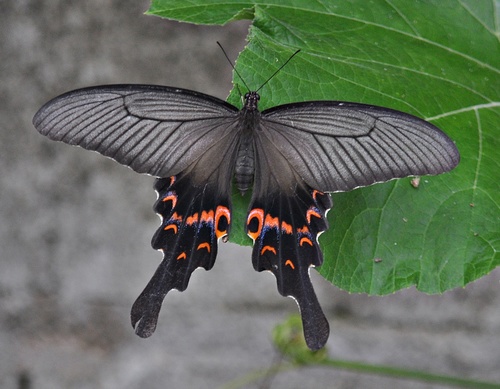
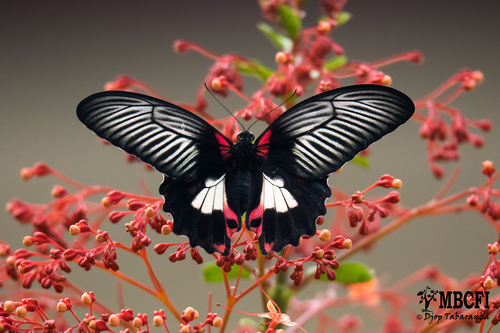
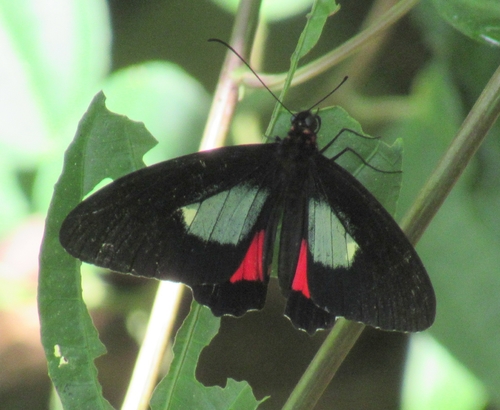
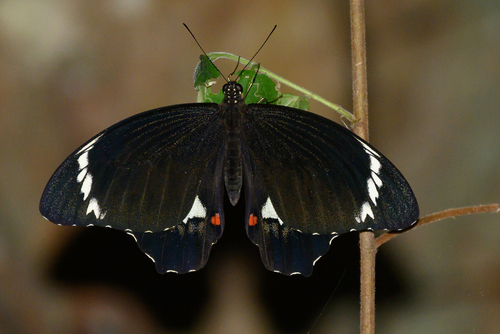
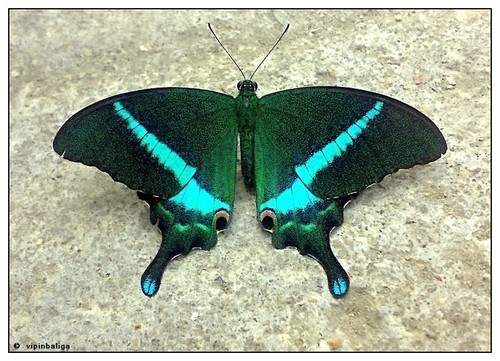
This butterfly species, Papilio crino, resembles Papilio palinurus. On the upperside of the outer half of the male forewing, there are typically cottony or hairy scent-streaks similar to those found in Papilio polyctor, though the streak in interspace 1 is always missing. Additional differences are visible on the upper wings. Compared to P. palinurus, the transverse bluish-green discal band of the forewing is slightly sinuous, narrower, more curved, and decreases more distinctly in width toward the costal margin; this band is more sinuous in females than in males. On the hindwing, the transverse bluish-green band varies greatly in width, but its inner margin is much straighter than that of P. polyctor. Unlike the band in P. polyctor which stops short of vein 7, this band continues to the costal margin, though it narrows much and abruptly above vein 7. The hindwing has a claret-red tornal ocellus with a large black centre, inwardly edged with blue; the bright ochraceous subapical lunule present in P. polyctor is replaced by a dull whitish spot here; diffuse subterminal green lunules are restricted only to interspaces 2, 3, and 4; the spatular apex of the tail bears a small patch of bluish-green scales. On the underside of the wings, the ground colour ranges from dull pale brown to blackish brown, and is irrorated (sprinkled) with scattered yellowish scales. These yellowish scales are absent from a large triangular discal patch on the forewing, which lies between the dorsum, the median vein, vein 5, and a line of white lunules that crosses the wing in an outward curve from the upper third of the costa to just before the tornus. These white lunules are diffuse on their outer edges and gradually merge into the brown ground colour. On the underside of the hindwing, the tornal ocellus is much the same as it appears on the upperside; there is an obscure, ill-defined, highly arched narrow postdiscal whitish band that runs from above the tornal ocellus to the costa, ending near the apex of interspace 7 in a broad white lunule; beyond this band sits a double subterminal row of somewhat straight ochreous-white lunules in the interspaces, with each lunule of the inner row bordered outwardly with blue, and this blue bordering is very faint in many specimens. The cilia of both the forewings and hindwings are brown, alternating with white. The antennae, head, thorax, and abdomen are dark brownish black; the upper surfaces of the head, thorax, and abdomen have a sprinkling of glittering green scales. The wingspan of Papilio crino ranges from 100 to 116 mm. This species is distributed in Lower Bengal, forested regions of central and southern India including Kerala, and Sri Lanka.