About Papilio cresphontes Cramer, 1777
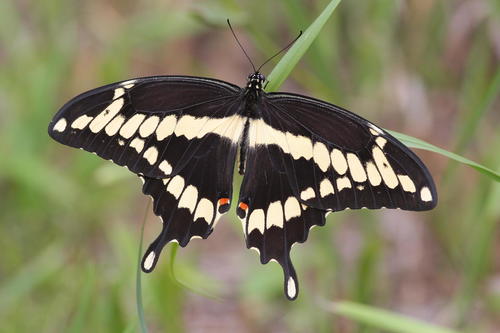
Papilio cresphontes Cramer, 1777, commonly called the eastern giant swallowtail, is most notable for its large size. Females have an average wingspan of 5.5 inches (14 cm), reaching a maximum of 6.9 inches (18 cm), while males have an average wingspan of 5.8 inches (15 cm), reaching a maximum of 7.4 inches (19 cm). Its wings are black with a horizontal yellow line across the forewings, and a diagonal yellow line across the hindwings. The underside of the wings is yellow with black accents. A small red patch on the ventral wing, located within the small blue band, distinguishes this species from the similar-looking Schaus' swallowtail. Adalbert Seitz described this taxon as usually considered a slightly different variety of Papilio thoas. It has no cell-spot on the forewing, and its fifth discal spot projects further than the sixth. In males, the claspers are separate above, the anal hook is quite short, the lower part of the anal segment differs from that of P. thoas, and the harpe is broad and rounded. This is a common species in eastern North America, ranging south to Costa Rica and north to southern Canada. It is a wandering species, found only occasionally in northern districts. In the United States, it does not extend west beyond the Mississippi plain except in the Southern States, and its core native range is the region adjacent to the Gulf of Mexico. It also occurs on Cuba. Papilio cresphontes is a member of the Papilio thoas species group. The eastern giant swallowtail is common across most of the United States, reaching as far north as southern New England and southern Canada. South of the United States, it occurs in parts of Mexico, Jamaica, and Cuba. Historically, this species was considered to range into the western United States and South America, but these western and South American populations are now classified as a separate species, the western giant swallowtail (Papilio rumiko), based primarily on DNA evidence. In the United States, P. cresphontes mostly inhabits deciduous forests and citrus orchards. This species can only overwinter in Florida and the deep South.