About Papilio constantinus Ward, 1871
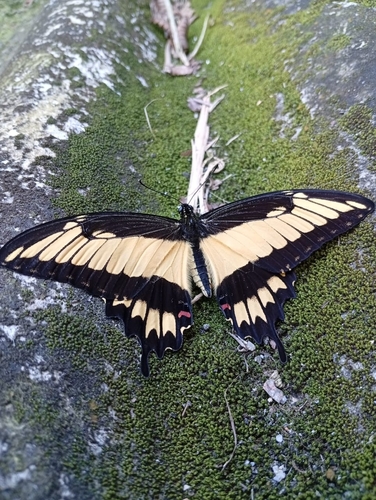
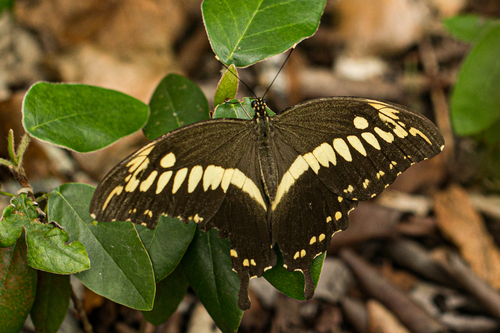
Papilio constantinus, commonly known as Constantine's swallowtail, is a butterfly species belonging to the family Papilionidae. This butterfly is found in Sub-Saharan Africa. Males have a wingspan ranging from 70 to 90 millimeters, while females have a wingspan ranging from 80 to 95 millimeters. Females are larger than males on average, and the species shows only low sexual dimorphism. On the upper (obverse) side of the wings, the base color is a rather dull brown. The forewings are paler at their base, and feature a broken white or cream band, a marking of the same color within the wing cell, a small number of additional markings at the wing apex, and a series of small submarginal markings. The hindwings have spoon-shaped tails, are paler at the base, and also bear a white or cream band and a series of submarginal markings of the same color. On the lower (reverse) side of the wings, the pattern of markings is similar, but the overall wing color is lighter. The brown areas are paler, but the wing veins remain dark brown, with additional dark brown lines present in the spaces between veins and within the forewing cell. The hindwings have a distinct orange spot at the anal angle. The butterfly’s body is cream-colored on its underside, with black lines running along the abdomen, and dark brown on its upper side. Its flight period occurs during the warmer months of the year, with peak activity between November and February. The larvae of Papilio constantinus feed on Vepris reflexi, Vepris lanceolata, Vepris undulata, Clausena species, Citrus species, Teclea trifoliatum, Teclea nobilis, and Teclea gerrardii.