About Papilio castor Westwood, 1842
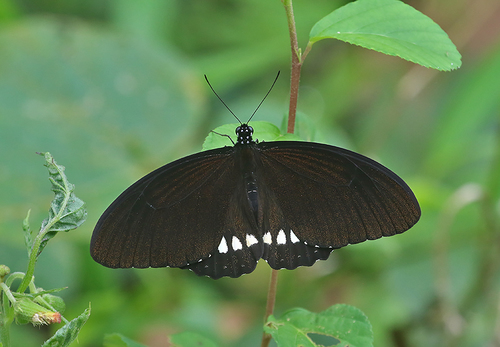
This description covers the male and female of Papilio castor. In males, the upper side of the wings is black, and is more or less sprinkled (irrorated) with yellowish-brown scales. On the forewing, these scales form somewhat indistinct longitudinal cell lines and internervular streaks. On the upper side of the hindwing, there is an upper discal cream-coloured patch, which is made up of an oval spot in interspace 4, a more elongate mark broadened outwardly in interspace 5, a similar elongate mark in interspace 6, and a much smaller broadly oval spot above these marks in interspace 7. These markings are not joined together, and are distinctly separated by black veins. The cilia of both forewings and hindwings are black, alternating with white. The underside of the male's wings is duller and more opaque than the upper side. The brownish-black apical area of the forewing and the base of the hindwing are thinly sprinkled with yellowish-brown scales. The underside of the forewing has a small white spot on the middle discocellular, plus a subterminal and a terminal row of small white specks that do not reach the costa. The markings on the underside of the hindwing are similar to those on the upper side, but they are smaller and more widely separated from each other by black-edged veins. There is also a subterminal series of small white lunules that is more or less well-defined, and a terminal series of white specks. The antennae, head, thorax and abdomen are all black. On the underside of the body, there is a spot behind the eyes, and white spots and specks on the thorax and abdomen. In females, the upper side of the wings is a duller, more opaque black than that of the male, and is more densely sprinkled with yellowish or reddish-brown scales. The forewing markings match those of the male, but females additionally have postdiscal and terminal series of small white spots that generally do not extend to the costal margin. The hindwing has a discal series of diffuse broad whitish streaks in the interspaces; these streaks extend into the apex of the cell. They are followed by a complete transverse curved subterminal series of white lunules. The ground colour beyond each lunule does not have the sprinkling of yellowish-brown scales, which creates the appearance of a row of terminal black spots on the wing. The cilia are black alternating with white. The underside of the female's wings is similar to the upper side, with white markings that are larger and more prominent. The forewing has diffuse whitish streaks in interspaces 1a, 1 and 2, and the subterminal and terminal series of white spots are complete. The hindwing has diffuse whitish streaks that extend all the way up to the base of the wing. The antennae are black; the head, thorax and abdomen are dull brown with white spots. This species is distributed in Northeast India, and extends into Myanmar, Bangladesh and Southeast Asia.