About Papilio canadensis Rothschild & Jordan, 1906
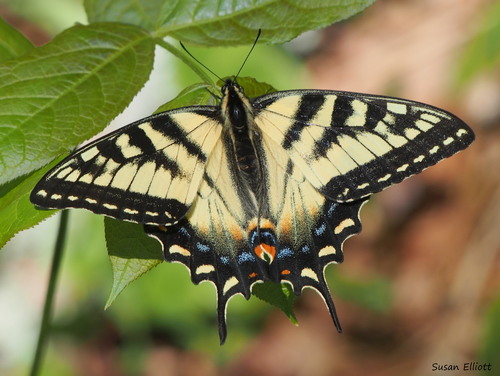
Papilio canadensis, commonly called the Canadian tiger swallowtail, is a butterfly species belonging to the family Papilionidae. It was historically classified as a subspecies of Papilio glaucus. As its common name suggests, this butterfly is found across most Canadian provinces and territories. Its range extends north of the Arctic Circle in the Yukon, and reaches as far east and south as Churchill in Manitoba, the Little Shagamu River in Ontario, and Schefferville in Quebec. It is not present in southern British Columbia, where it is replaced by the western tiger swallowtail, Papilio rutulus. It is also absent from parts of southwestern Ontario approximately west of Toronto, where it is replaced by the eastern tiger swallowtail. It has never been reported from Labrador, but has been observed in western and central Newfoundland. Populations also occur in the northern third of the United States. Across its entire range, the Canadian tiger swallowtail is a very common and well-known butterfly, particularly abundant near woodland edges. It is one of the most well-documented puddling butterfly species, and hundreds of individuals will often gather at a single puddle. Adults of this species fly during spring and summer, and only one brood is produced each year. Females lay their eggs singly on the leaves of their host plants. After hatching, caterpillars fold their host plant’s leaves and bind them together with silk to create a shelter, from which they feed. Pupae overwinter and emerge as adults in May. Adult Canadian tiger swallowtails feed on nectar. Recorded larval host plants include Betula (birches), Populus (poplars, aspens, and cottonwoods), Malus (apple trees), and Prunus serotina (black cherry).