About Papilio buddha Westwood, 1872
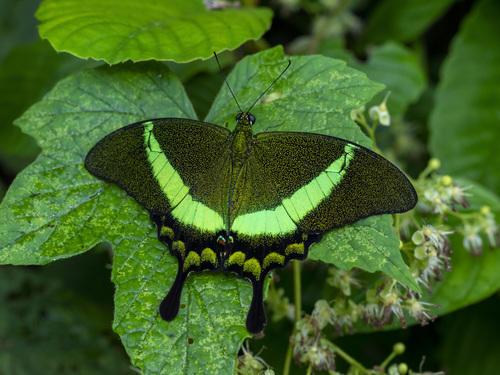
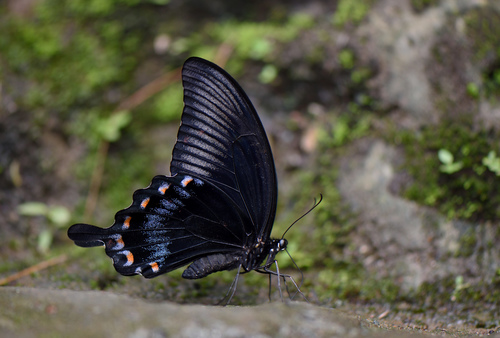
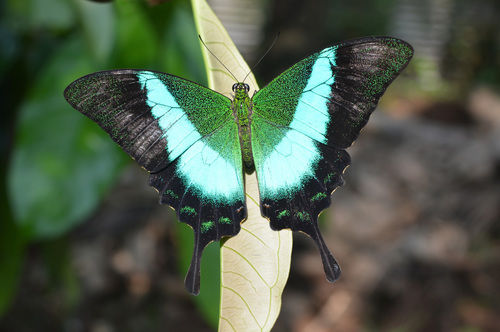
Papilio buddha resembles Papilio palinurus, but it is larger in size. There are also differences on the upperside of its wings: the irroration of green scales is more restricted. The outer half of the forewing, except for a triangular patch extending downwards from the wing apex, and the outer third of the hindwing, except for a subterminal series of poorly formed lunules, have no green scales. The transverse discal bands on both the forewing and hindwing are similar to those of P. palinurus, but are much broader. When measured along the dorsum, the forewing discal band occupies considerably more than one-third of the total dorsal length. On the hindwing, the discal band is equally broad across its anterior and posterior sections; in P. palinurus, this band is much narrower at the posterior end. The ochraceous tornal ocellus of P. buddha is brighter in color, and is not topped with blue. The subapical ochraceous lunule in interspace 7 is also brighter and significantly larger. The underside of P. buddha's wings is similar to the underside of P. palinurus's wings. However, on the hindwing of P. buddha, the ochraceous lunules of the subterminal series are proportionately narrower, and have much more prominent silvery white borders along their inner edges. Antennae, head, thorax, and abdomen match the corresponding features of P. palinurus. The total wingspan of Papilio buddha ranges from 107 to 155 mm.