About Papilio brevicauda Saunders, 1869
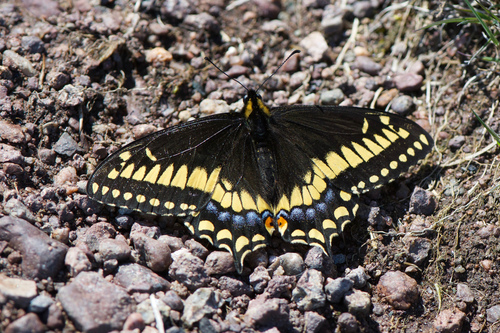
The short-tailed swallowtail (Papilio brevicauda Saunders, 1869) is very similar to the male black swallowtail (Papilio polyxenes), but has shorter wing tails and a rounder forewing tip. The yellow bands of spots on the upper surface of its wings are often more orange in color, an exception to this pattern occurs in the western part of the species' range. This butterfly primarily breeds on Scotch lovage (Ligusticum scoticum), and is most often found very close to the ocean, where its larval food sources grow. It especially favors headlands that host Scotch lovage and other members of the parsley family Apiaceae, including cow parsnip (Heracleum species) and purplestem angelica (Angelica atropurpurea). It is a very strong flier, so windy locations do not hinder it. Males search for females by waiting for them on hilltops. Females lay their eggs one at a time on the leaves of host plants. Newly laid eggs are cream-colored, and later develop a reddish-brown ring around them. Pale green to creamish-green larvae have black bands between their body segments, with yellow spots located on these black bands; the spots are orange on individuals from Cape Breton Island. The chrysalis can be either green or black-brown, and it overwinters. The short-tailed swallowtail produces one brood per year, and may sometimes produce a second partial brood.