About Papilio bianor Cramer, 1777
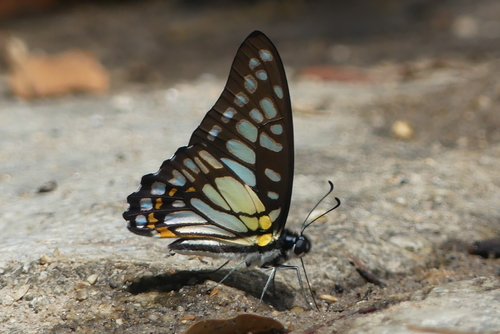
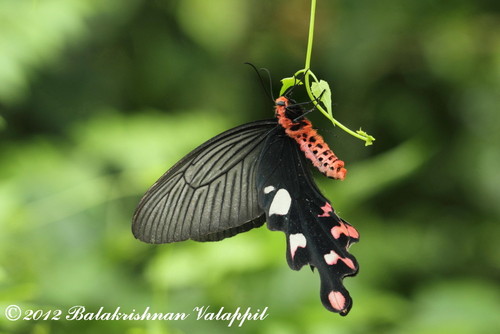
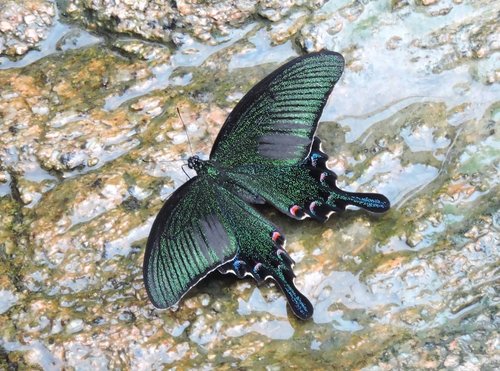
Papilio bianor Cramer, 1777 is variable in size. Individuals that emerge in spring reach 4 to 8 centimeters across, while those that emerge in summer can reach 12 centimeters across. The forewings are black with dark veining and green scales. The undersides of the forewings are brown, turning white toward the distal end and still marked with dark veining. The hindwings are tailed, have ridged edges, and contain reddish eyespots. The body is black with green scales. Males have black hair on their forewings, a trait that females lack. As described in Seitz, this species is very variable both geographically and seasonally. For males, the pilose stripes are broad; the posterior three are usually united. When the stripes are separated, the stripe of the lower median remains broader than the interspace that separates it from the stripe of the submedian fold. The upper surface of the male forewing is dusted with green or green-blue scaling, and this scaling is commonly condensed into a band before the narrowly dark distal margin. The upper surface of the male hindwing is blue or blue-green anteriorly and dusted with green posteriorly, and it usually bears a more thickly scaled large green or blue patch (or a similar band), a red anal spot, 0 to 4 red submarginal spots, and at least anteriorly some distinct green submarginal spots. The black basal area on the underside of the forewing always extends beyond the base of the upper median, and sometimes the entire forewing is black. The underside of the hindwing has a complete row of red submarginal spots. Females have less dense metallic scaling than males, and the red spots on the upperside of the female hindwing are usually more numerous and larger than they are in males. This butterfly occurs from North Japan to Tonkin and West China, and it appears to be fairly common across all its localities, sometimes occurring in profusion. Like its allied species, males congregate on moist sand and visit flowers. The larva is green with 2 to 8 light oblique bands, and feeds on Aurantiaceae. This account is adapted from Karl Jordan in Seitz.