About Papilio astyalus Godart, 1819
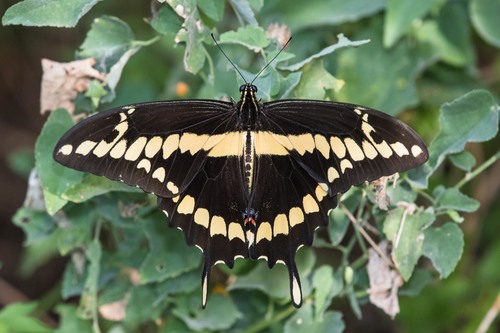
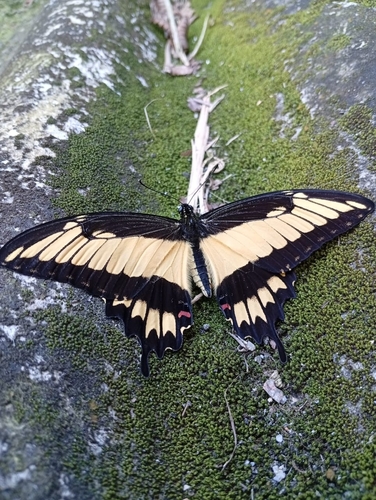
Papilio astyalus, commonly called the broad-banded swallowtail or Astyalus swallowtail, is a butterfly species belonging to the family Papilionidae. Its range extends from Mexico south to Argentina. It is occasionally reported from southern Texas, and rare stray individuals can be found as far north as southern Arizona and northern Texas. This species has a wingspan of 117–120 mm. Male individuals have black wings. On the upper side, the forewings are crossed by a wide yellow band that is intersected by black veins. There is a small yellow spot in the forewing cell, and a series of yellow spots in the submarginal region. The hindwings have tail projections, a yellow band that continues the forewing's yellow band, submarginal yellow spots, and an orange-red ocellus topped by an iridescent blue lunule in the anal angle. On the underside of the wings, the pattern is similar to the upper side, but the forewing cell is striped with yellow, and the black area of the hindwing is smaller. The hindwings also have a series of iridescent blue lunules that are topped by orange-red lunules. Female P. astyalus are darker than males and lack the broad yellow band found on males. On the upper side, the forewings are dark brown, paler in the submarginal area, and bear a series of submarginal yellow spots. The hindwings are dark brown, with a series of submarginal red, iridescent blue, and yellow spots, an orange ocellus in the anal angle, and smaller tails than males. The underside pattern is similar to the upper side, but blue spots are smaller and are topped by orange-red lunules. Males have yellow bodies on the underside and along their flanks, and black bodies on the upper side; females have entirely black bodies. This species is very similar to Papilio thersites. Adult P. astyalus are in flight from April to October. There are most likely two generations per year. The larvae feed on the leaves of Citrus trees. Adult butterflies feed on nectar from a variety of flowers, including species of Lantana.