About Papilio ascalaphus Boisduval, 1836
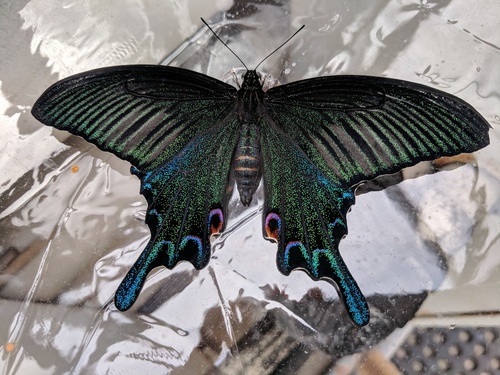
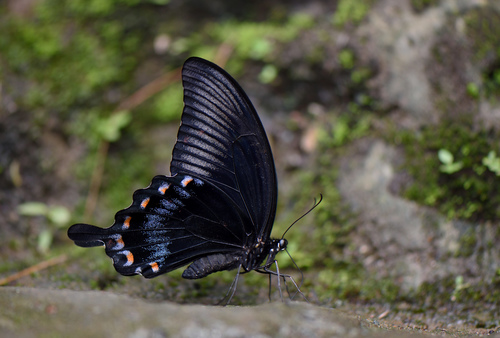
Papilio ascalaphus, commonly called the black phoenix or Ascalaphus swallowtail, is a butterfly species belonging to the family Papilionidae. It is distributed in Indonesia and the Philippines. The wingspan of this butterfly ranges from 140 to 160 mm. The underside of its body has almost no traces of grey-white longitudinal lines, and its palpi bear a white spot. Both sexes have tails and lack patches at the wing base, on both the upper and lower wing surfaces. Before the distal margin, the forewing has yellowish-grey markings, and the hindwing has grey-blue or yellowish-grey stripes. On the underside, the forewing stripes are positioned closer to the disc. The hindwing stripes are replaced by much shorter grey-blue discal spots, with yellow, more or less blue-shaded submarginal spots placed distally to these spots. Females are very distinct from males. In females, the forewing is black from the base to approximately the second median vein, followed by a large central white area that narrows posteriorly, intersected by black stripes, with a broad black distal margin. The hindwing has a large white central area interrupted by veins. In a second female form, this white area is only marked by indistinctly defined grey and bluish patches. The red-yellow submarginal spots, which have white tips, are well developed on both the upper and lower wing surfaces. Earlier life stages of this species have not been formally described. Yellow eggs are laid on Citrus plants, and larvae live and feed on Citrus species. This butterfly is very common, particularly at lower elevations near the coast. It is frequently found feeding on Papaya flowers. Females prefer hiding in the foliage of Citrus trees, and will fly around even in gardens and the streets of Macassar, as noted by Fruhstorfer. The nominate subspecies P. ascalaphus ascalaphus (ascalaphus Bdv., 88 a) is found on Celebes. Males have a broad grey-blue band made up of stripes on the upper surface of the hindwing. Most females normally have a large white discal area on the hindwing, but occasional specimens have this area replaced by indistinct blue-dusted grey patches; this darkened female form, female-ab. nubiger Fruhst., is only recorded from North Celebes according to Jordan. The subspecies P. ascalaphus ascalon (ascalon Stgr., 28 a) is found on Mangola in the Sulla Islands. In this subspecies, the stripes on the upper surface of both wings are short and yellowish, and are much less prominent on the hindwing than in nominate ascalaphus. The central section of the female forewing and the hindwing discal area are purer white than they are in nominate ascalaphus.