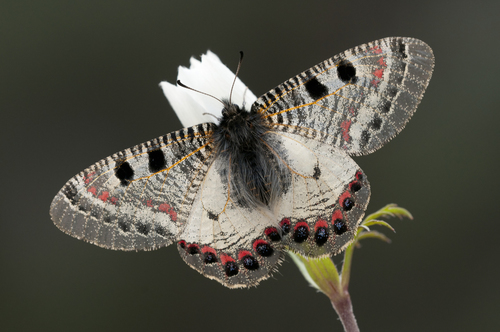
About Papilio arcturus Westwood, 1842
This description covers male and female individuals of Papilio arcturus. For males, the upper side of both wings is brownish black, with the forewing somewhat paler than the hindwing. The forewing is sprinkled (irrorated) with brilliant golden-green scales. On the posterior half of the forewing, these scales form a broad, poorly defined subterminal band. The veins and the elongate streaks between them on the outer half of the forewing are velvety black. The posterior three-fourths of the hindwing is irrorated with brilliant golden-green scales the same as the forewing, but towards the anterior base, these scales are blue. A conspicuous, irregularly shaped brilliant blue patch covers the apex of the cell and the bases of interspaces 5 and 6, and it extends as a broad streak through interspace 6 all the way to the terminal margin. Below this blue patch, a more or less triangular discal patch, and above the blue patch the entire broad costal margin, do not have the green scale irroration. A generally incomplete subterminal series of large claret-red lunules ends at the tornal angle in a large, conspicuous red ocellus with a black center. This ocellus is encircled above and anteriorly by a narrow band made of confluent green-irrorated scales. The lunules are bordered outwardly by ground-colour spots that lack green scales. Finally, both the lunules and the tornal ocellus have more or less bluish purple tinging on their inner margins. The underside is dull black, with a somewhat sparse irroration of yellowish-white scales. On the forewing, these scales are confined to the base and apex. On the hindwing, they are confined to the posterior two-thirds, and only reach the termen along the tail. The forewing has a broad, poorly defined pale subterminal transverse area, which is crossed by black veins and black internervular streaks, plus elongated pale cellular streaks. The hindwing has a large, somewhat quadrate claret-red terminal patch with a black center in interspaces 1 and 2, and a subterminal series of broad claret-red lunules extending from interspaces 3 to 7. These are followed by poorly defined anteciliary red spots in each interspace. The cilia of both the forewings and hindwings are white, alternating with black. Antennae, head, thorax and abdomen are brownish black; the upperside of the base of the head, thorax and abdomen is sprinkled with golden-green scales. Females are similar to males, but their markings are more prominent. On the upperside of the female forewing, the subterminal golden-green band is broader, and on the female hindwing the subterminal series of claret-red lunules is more complete than it is in males.