About Papilio androgeus Cramer, 1775
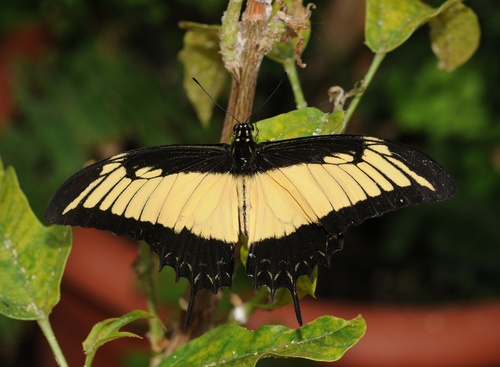
This species shows strong sexual dimorphism between males and females. Its wingspan ranges from 134 to 140 millimeters. All wings have a black-brown base color. Males have very broad yellow bands on the upper sides of both forewings and hindwings. Indistinct yellowish and bluish spots are present on the outer edge of the hindwings, and these spots are sometimes absent. The underside of male wings has a similar pattern to the forewings, but is much paler and less distinct, while the outer edge spots are somewhat more pronounced. Females have more variable wing markings. They often have large white spots on the dark upper surface of the forewings, but these spots can also be completely absent. The female hindwings have a more or less metallic blue or turquoise shimmer, and bear blue-green spots on their outer edge. On the brownish underside of female wings, there are three rows of crescent-shaped red, blue, and yellow spots along the outer edge of the hindwings. Both sexes have five to six narrow, unmarked, blackish tails on the hindwings, one of which is somewhat elongated. Fully grown caterpillars range in color from olive green to blackish brown. An orange line is visible in the neck area. A green-white, saddle-shaped thickening stands out in the middle of the body. There are also several small warts on the back that bear bluish spots. The pupa is dark brown with vertical cream stripes, and the wing sheaths have a greenish shimmer. Male P. androgeus of the piranthus form have two large yellow patches on the forewing, sometimes with an additional small spot; in female P. piranthus these spots are absent or only faintly indicated, and the metallic scaling of the hindwing is not dense and extends into the cell. According to Seitz's description: For P. androgeus, like the preceding related species, the sexes differ, and females occur in two forms across many regions. The tail is narrow and pointed. The upper side of the hindwing has narrow bluish submarginal crescents, and the underside has a regular row of reddish yellow crescents between the cell and the outer margin. Larvae feed on Citrus, and are similar to the larvae of P. lycophron; like that species, the pupa has two rows of small tubercles on the upper side of the abdomen. Adult butterflies are common in open country, gardens, and wood edges. Their distribution ranges from the West Indies and Mexico south to Paraguay and southern Brazil. The subspecies epidaurus Godm. & Salv. occurs on Cuba, Haiti, and St. Lucia, and also inhabits Central America from Mexico to Panama. Males of this subspecies have a very broad yellow area, and show indications of a yellow band outside the forewing cell; the grey-blue scaling on the hindwing is dense. The nominate subspecies androgeus Cr. (male = policaon Cr.) (10a) has males with a less pale yellow area than the following subspecies. Females occur in two forms: the female-form androgeus Cr. (10a) has two large yellow patches on the forewing, sometimes also a small spot; in the female-form piranthus Cr. these spots are absent or only faintly indicated, and the metallic scaling of the hindwing is not dense and extends into the cell. This subspecies ranges from Colombia to Bolivia, Mato Grosso, and Pará. Subspecies laodocus F. (10a) inhabits mainland Brazil, south to Paraná. The yellow area of males is pale, the small spots located before the end of the cell are smaller and often entirely absent. Only one female form is known; this form is similar to the female-form androgeus of the preceding subspecies, but the upper yellow spot is smaller than the second.