About Papilio anchisiades Esper, 1788
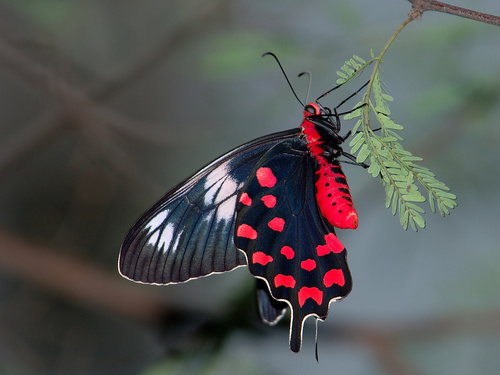
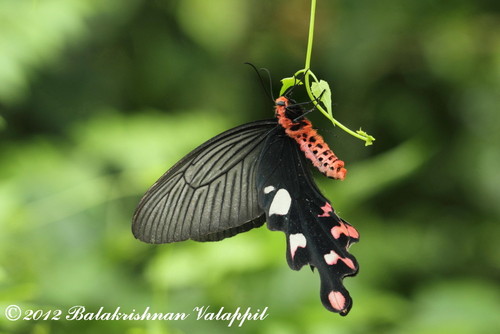
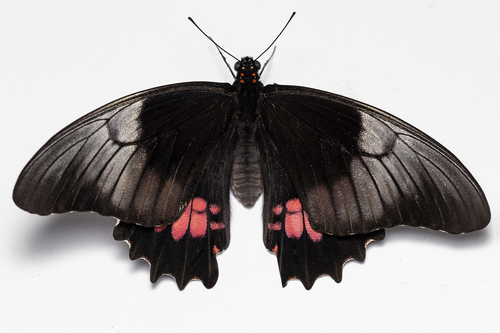
Scientific name: Papilio anchisiades Esper, 1788. Description from Seitz: Wingspan is 70–100 mm. P. anchisiades is a widely distributed, variable species. The hindwing is somewhat prolonged on the posterior side, and less triangular; the tail is either absent, or only slightly longer than the other marginal teeth, though it can sometimes be as long and pointed in females as in the related following species. The two rows of red spots on the underside of the hindwing are partly contiguous, or at least two pairs of spots are positioned very close together. Larvae often rest together in groups of hundreds on the stems of citrus plants. This is a very common insect that prefers to drink from moist places on river banks; it is not a forest species. Subspecies idaeus F. (= pandion Feldr., pandonius Stgr.): The forewing usually has a distinct white spot at the end of the cell, visible on both the upper and underside, or only on the underside. This subspecies occurs in Central America, from Mexico to Panama. Subspecies anchisiades Esp. (= anchises L. partim, theramenes Fldr, pompeius Kirby) (10d): This subspecies is very variable. The forewing has two white spots posterior to the 1st median vein, present on both sides or only the underside; it also has a spot before the 1st median on the underside that is rarely present above, and sometimes has an additional spot before the 3rd radial. In other specimens, the white spots are absent from the upper side: the forewing is dark from the base to the apex of the cell, then paler further out, and has a row of white spots on the underside. This subspecies ranges from Colombia to Para and Bolivia. Subspecies capys Hbn. (= evander Godt.) (10c): The forewing has no white spots on the upperside; the disc area is paler, the dark proximal area has a rounded shape; there is a row of white spots on the underside, one of which is located in the cell. This subspecies is found in East Bolivia, North Argentina, Paraguay and Brazil. The larvae of Papilio anchisiades feed on various species in the plant family Rutaceae, including Citrus, Casimiroa, and Zanthoxylum species. Adult butterflies feed on flower nectar.