About Papilio amynthor Boisduval, 1859
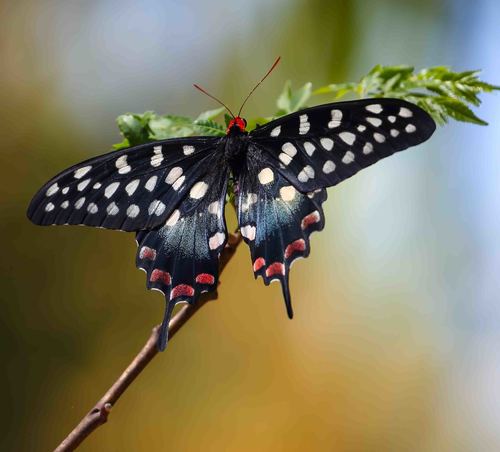
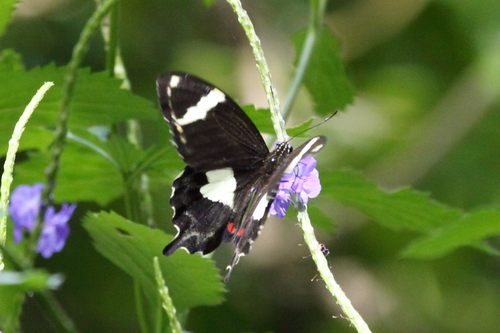
This description was originally published for the taxon previously referred to as P. ilioneus by Karl Jordan in Seitz, for the species now classified as Papilio amynthor Boisduval, 1859. Palpi are entirely white along their lateral sides. The underside of the abdomen has a total of 5 thick yellowish-white lines along the sides and midline. For males: the upper surface of the forewing has an oblique band of white spots distal to the cell, and a row of white submarginal dots before the distal margin. Usually the first of these dots, located before the fourth subcostal vein, is distinct. The hindwing has a white discal area extending from the costal margin to the first median vein, or slightly beyond it. The third patch in this area is always the largest, the final patch is small and positioned close to the cell, and the apex of the cell is always white. The fringe spots are large and white. On the underside: the forewing matches the pattern of the upper surface, but the oblique band is broader, and all submarginal spots except the final one are well developed. A short, linear, transverse white discal spot is present before the submedian vein. The discal band of the hindwing extends all the way to the anal margin, and there is a complete row of submarginal spots. The first and last of these spots are large, rounded, yellow-red with yellowish-white margins, while the remaining spots are yellowish-white with red dots. Females are paler brown than males; their forewing markings are yellowish and larger than the equivalent markings in males, and they have a triangular patch located two-thirds of the way toward the hindmargin. This species occurs on New Caledonia, the neighboring Loyalty Islands, and Norfolk Island. Two forms are recognized. The first is ilioneus Don. (= amphiaraus Fldr.), found on Norfolk Island. In this form, the subapical band on the upper surface of the forewing is broad and yellowish; the submarginal spots on the underside of the hindwing are large, with the second and third spots at least as large as the black spots positioned between these spots and the yellowish-white discal area. The second form is amynthor Bdv. (= abstrusus Btlr.) (27 c), found on New Caledonia and the Loyalty Islands, where it is apparently common. In this form, the subapical band of the forewing and the posterior patches of the yellowish-white area of the hindwing are less narrow than in the ilioneus form; the forewing band is narrower, and the submarginal spots on the underside of both wings are smaller.