About Papilio ambrax Boisduval, 1832
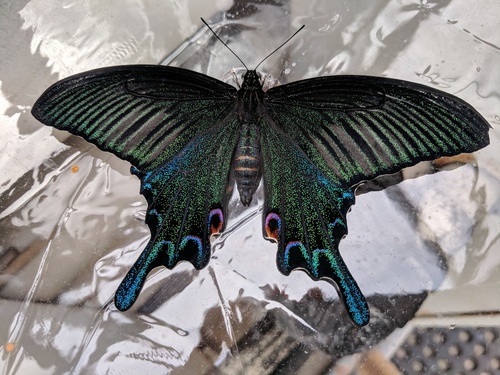
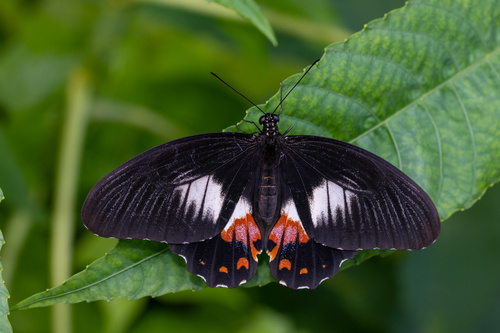
Papilio ambrax Boisduval, 1832 has a wingspan of 90–100 mm (3.5–3.9 in). It is very closely related to Papilio polytes, and neither sex has a tail. In males, thin marginal spots on the forewing are confined to the wing’s edge. The upper surface of the male hindwing has a large white area that always extends into the wing cell, and is much broader than the black marginal area; this white area is entirely absent on the underside of the hindwing, or replaced by rounded, shadowy white-grey spots. In females, thin marginal spots appear on both wings, and are smaller than the marginal spots of all forms of P. polytes. There is no sign of nail-head spots on the black distal margin of the female forewing. On the underside of the female hindwing, extremely small yellow-grey scales sit between the veins in the basal area, just as in males. The white area of the female hindwing is similar to that of P. polytes nicanor, but the veins, especially the apex of the cell, are even less darkened by black scaling. No female form of Papilio ambrax resembles the male. Fully-grown larvae are green. They have a broad stripe along the lateral sides of the ventral body that also covers the prolegs, and this stripe is edged with whitish along its upper margin. Besides an anal band of the same whitish colour, three additional uninterrupted bands of this colour branch off from the lateral stripe. A transverse band is additionally located on the thorax, which widens laterally into a spectacle shape. This butterfly is very common, as documented by Karl Jordan in Seitz. The larvae feed on Citrus species, Clausena brevistyla, Limonia acidissima, Microcitrus garrawayae, Microcitrus inodora, Murraya koenigii, Zanthoxylum ailanthoides, Zanthoxylum brachyacanthum, Zanthoxylum nitidum, Zanthoxylum ovalifolium, and Morinda citrifolia.