About Papilio alcmenor Felder & Felder, 1864
This is a description of the butterfly species Papilio alcmenor Felder & Felder, 1864, covering differences between male and female individuals.
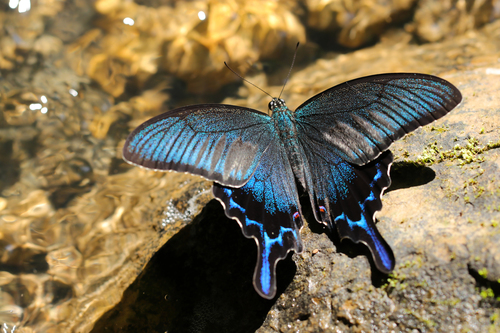
For males, the upperside of the wings is black, with a faint dark indigo-blue tint visible in some lighting. On the forewing, there is a series of pale streaks along the veins. These streaks do not reach all the way to the wing base or the terminal edge, but do extend well into the apical half of the cell. A short, thin red streak, which is rarely absent, is located at the extreme base of the subcostal vein. In some specimens, the apical half of interspace 1a and the posterior portion of interspace 1 are diffusely white. The hindwing is uniformly colored, with bluish scales scattered across its terminal or outer half. At the tornal angle, there is an irregular incomplete white ring that encloses a black spot, which is bordered above by red.
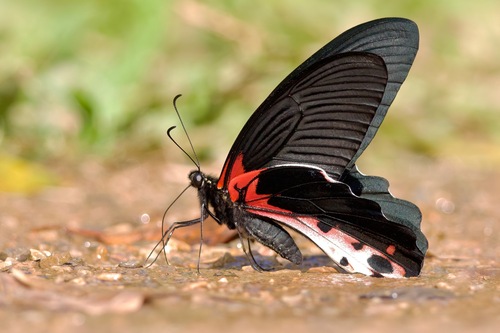
On the underside of male wings, the forewing pattern is similar to the upperside, but is shaded buff, and the pale vein streaks are broader and much more prominent, giving the wing an overall grey appearance. A dark red patch at the base of the forewing is crossed by the black veins. The male hindwing underside is deep indigo-blue black. It has a dark red base patch just like the forewing, but this patch continues along the dorsum, almost completely filling interspaces 1 and 2. Two black spots and some irregular white scaling sit over the red area in interspace 1, while three large black spots are arranged in sequence from the base in interspace 2. In some specimens, the two apical spots join together on the anterior edge, and some specimens also have a red lunule near the apex of interspace 5. Finally, there is a diffuse patch of blue scaling near the apices of interspaces 6 and 7. The antennae, head, thorax, and abdomen are black, and are paler on the underside.
For females, the upperside ground color is a duller black than in males. On the forewing, the vein streaks are broader, paler, and more prominent than they are in males, and the short red streak at the base of the subcostal vein is broader. On the female hindwing upperside, there is a medial white patch made up of an elongated spot at the base of interspace 4, and a short streak that fills the basal half of interspace 5. This white patch extends diffusely into the apex of the cell and upward into interspace 6. Beyond this white patch, there is a discal series of three small red crescent-shaped marks in interspaces 2, 4, and 5, or sometimes only in interspaces 2 and 4. These are followed by larger red lunules in interspaces 2 to 5, large marginal red spots in interspaces 2 and 3, and a more or less large rectangular red spot with a black center at the tornal angle. The cilia have white markings in the middle of each interspace. The red lunular markings vary greatly in number, and are located along the margin in interspaces 4 to 6.
On the underside of the female forewing, the ground color is dull olivaceous black, with the veins and interveinal streaks being velvety black, and a red patch at the base of the cell. On the female hindwing underside, the ground color is black. Markings are more or less similar to those on the hindwing upperside, but both the white and red markings are more extensive. The red markings form a patch at the base of the wing and a broad dorsal border below the median vein and vein 3; this red area is interrupted by large black spots in interspaces 1, 2, and 3. The female antennae are black, while the head, thorax, and abdomen are dull dark ochraceous brown.
This species occurs in North-eastern India, Nepal, Bhutan, Myanmar and China.