About Papasula abbotti (Ridgway, 1893)
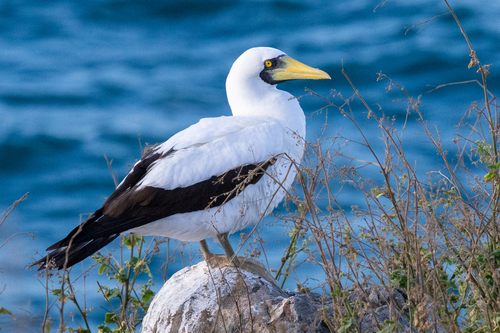
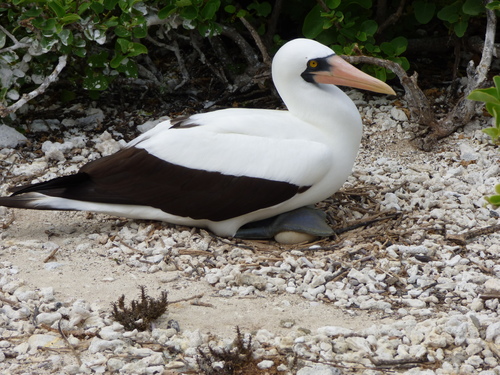
Abbott's booby, scientific name Papasula abbotti (Ridgway, 1893), is the largest booby species, adapted for long-distance flight. Adults measure up to 80 cm (31 in) from beak to tail and weigh approximately 1.5 kg (3.3 lb). This species can be told apart from other local sulids by its black-and-white plumage. The only other bird with similar shape and coloration is the masked booby, which has an entirely white body with only black wings. Abbott's booby has off-white base plumage that contrasts with black eye patches, black wings and tails, and black flank markings. Its feet are blue, webbed, and have black outer edges. Males have pale grey bills with black tips, while females have pink bills with black tips. Newly hatched chicks are covered in white down and have a cape of black scapular feathers. Unlike juvenile boobies of other species, juvenile Abbott's boobies have plumage that already resembles that of adult birds. Currently, Abbott's booby is the only booby species restricted to a single primary breeding location, though its historic range spanned most of the Indian and Pacific Oceans. Fossil evidence confirms the species was once present in the South Pacific, and historical eyewitness accounts note former breeding colonies on the Mascarene Islands. In April 2007, an individual Abbott's booby was photographed at a booby colony on the Pacific island of Rota; this same individual has been spotted intermittently in the local red-footed booby colony through at least 2024. The species breeds in tall trees within the plateau forests of central and western Christmas Island, as well as in the upper terrace forests of Christmas Island's north coast. Nests are distributed unevenly in patches shaped by local topography, with most nests located in trees on uneven terrain. Nests are most often built in Syzygium nervosum and Planchonella nitida trees, though emergent Tristiropsis acutangula trees are sometimes used. Between April and November, southeast trade winds blow through the region, so trees that can be accessed from the northwest are preferred for nesting. The species' typical foraging range extends 40–100 km (25–62 mi) from Christmas Island, but individuals are frequently sighted near Indonesia, and vagrant birds have been recorded as far as mainland Australia. The recent observation of a single female on Rota, located northeast of Guam in the Pacific, combined with records of the species from the Banda Sea, suggests either that Abbott's booby has a larger range than previously documented, or that undiscovered breeding colonies exist elsewhere. Abbott's boobies are solitary long-distance travelers that can range thousands of kilometers from their breeding grounds on Christmas Island. They are highly vocal, with a wide variety of distinct calls. Their large size means they need a large clear space to take off, so they nest near the tops of tall trees. If an individual falls to the forest floor, it will starve to death unless it can climb high enough to catch wind for takeoff. Adult boobies rarely fight with one another, due to the high risk of falling. Fledglings must successfully complete their first flight attempt to survive; most failed attempts result in the fledgling's death. Between October and April, adult boobies forage at sea, but they will return to the breeding site if they have a still-dependent chick. They forage in offshore waters, feeding on fish and squid. No consistent feeding patterns have been documented, though researchers suspect they forage in an ocean upwelling off the coast of Java, 300 km (186 mi) northwest of Christmas Island. For the first two weeks of life, chicks are fed via complete regurgitation from their parents, after which they are fed via incomplete regurgitation. Both parent birds participate in feeding the young.