About Panus conchatus (Bull.) Fr.
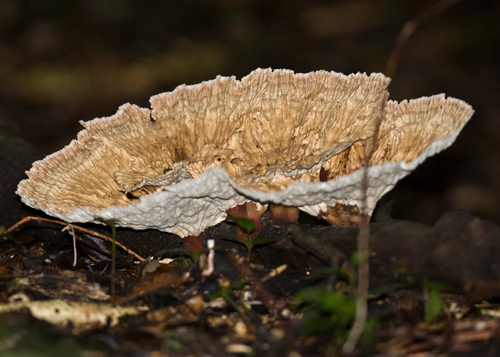
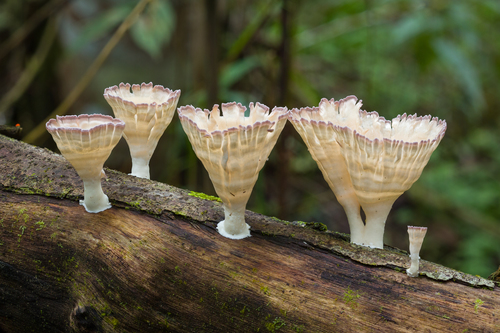
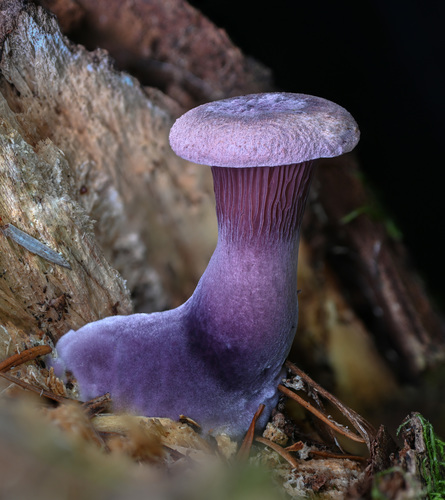
Panus conchatus (Bull.) Fr. has caps 3 to 17 centimetres (1 to 6+1⁄2 inches) wide. Caps start convex, then flatten with age, and sometimes become depressed in the center. Caps are tan, lilac, or reddish-brown, with a smooth, glabrous surface; older caps may crack into small flattened scales. The cap margin is inrolled, and often has a wavy or lobed outline. Its flesh is tough and whitish. Gills attach decurrently, running down the length of the stem, and are narrow and often forked. Young gills have a violet tinge, and mature gills turn light yellow or reddish-violet. The stem measures 1.5 to 5 cm (1⁄2 to 2 inches) long and 0.5 to 3 cm (1⁄4 to 1+1⁄8 inches) thick. It is roughly the same color as the cap, covered in violet hairs, and attaches to the cap laterally or off-center. The spore print of this species is white. Under a microscope, spores are elliptical, smooth, and non-amyloid, with dimensions of 5–7 by 2.5–3.5 μm. Pleurocystidia are either ventricose (enlarged in the middle) or capitate (enlarged and spherical at the tip), with dimensions of 35–45 by 8–11 μm. Panus conchatus is a saprobic species that gets its nutrition from rotting or decaying organic matter. Its fruit bodies grow on hardwood stumps, logs, and sticks, usually crowded together in clusters. Typical host woods include deciduous trees, especially beech, poplar, birch, and oak, and less often ash and elm. It also grows on coniferous hosts including fir, spruce, pine, and yew. This species is found throughout the Northern Hemisphere, and has been collected in North America and Europe. In eastern North America it can be found from April to August, and on the West Coast from December to June. Although it is believed to be non-toxic and sometimes eaten when young, P. conchatus is not recommended for consumption because of its tough, leathery texture. Panus conchatus produces a laccase, a type of polyphenol oxidase enzyme. Laccases have potential industrial applications for pulp bleaching, mill wastewater treatment, and removal of phenolic compounds in the food industry. Most laccases are known as blue copper phenol oxidases, with an active site that holds four copper molecules. P. conchatus instead produces a white laccase that does not have the typical blue copper color. In experimental studies, the crudely purified enzyme from this species has been used for pulp bleaching and wastewater decoloration.