About Panurus biarmicus (Linnaeus, 1758)
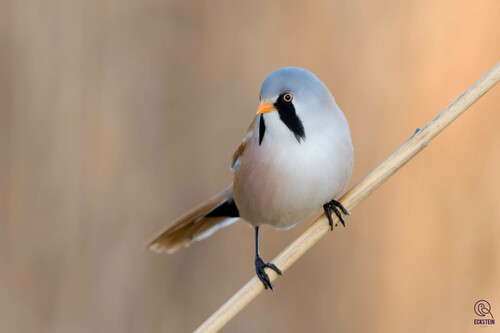
The bearded reedling, with the scientific name Panurus biarmicus, is a small, long-tailed passerine bird that inhabits reed beds near water in the temperate zone of Eurasia. It is often called the bearded tit or bearded parrotbill, because historically it was thought to be closely related to tits or parrotbills. We now know it has no close relatives, and it is the only species in the family Panuridae. Bearded reedlings are strongly sexually dimorphic, form life-long pairs, are highly productive, and can breed multiple times in a single season. They primarily eat small invertebrates during summer, and switch to plant seeds during winter.
This species is native to temperate Europe and Asia, with a range extending from Spain, France and the British Isles to the Manchurian region. Its distribution is generally patchy due to its specific habitat requirements. Maps often show most of its Asian range as a single large continuous area rather than patchy, but this reflects limited monitoring data for the region compared to the western part of its range. In Europe, the species was historically restricted to mid and low latitudes, including Great Britain, but it expanded north into Scandinavia, Finland and the northern Baltics during the second half of the 20th century. It is an occasional non-breeding visitor to Cyprus and Iran, and has rarely been recorded as a vagrant outside its normal range to the west, south and east in Portugal, North Africa, Israel, Kuwait, Pakistan, Japan and Korea.
Bearded reedlings are generally resident, and no population is known to follow a clear, consistent migration pattern. However, some European populations, primarily those in the northern half of the continent, move south or southwest during the non-breeding winter season, in what can be described as short-distance migration of up to a few hundred kilometres. This movement never involves an entire population in any region: some birds move, while others remain in their breeding range year-round. Both adults and young may make eruptive dispersals outside the breeding season, and during periods of cold weather or limited food, they may make other, mostly local movements.
The bearded reedling is a habitat specialist that lives in reed beds, primarily those dominated by common reed, beside fresh or brackish water lakes, swamps or rivers. It also occurs in nearby tall grass-like vegetation such as bulrushes and true sedges. During the breeding season, it strongly avoids non-floodable or dry parts of wetlands, but it may wander more freely at other times of year. Although it typically perches or climbs on reeds and similar vegetation, it readily hops on the ground, especially in swampy areas or at the water's edge. It has a wide altitudinal range, mostly occurring from sea level to medium altitudes, but has been recorded up to 3,050 m (10,010 ft) above sea level in China.
Bearded reedlings are social. During the non-breeding season, they are usually found in groups of up to a few tens of birds, and exceptionally in groups as large as two hundred. During the breeding season, they are most commonly seen in pairs, family groups, or groups of independent young. Young birds form pairs while still juveniles, just a few weeks after fledging. Once a pair forms, the partnership is generally life-long: the pair stays together year-round, even sleeping close to one another. If one pair member dies, the surviving bird will join groups of young to find a new partner. Pairs are monogamous, though infidelity (mating with another individual) is not uncommon for either sex.
The length of a male's black "moustaches" is an honest signal of his dominance; in competitions for food between males, the individual with the longest moustaches usually wins. Females prefer males with longer moustaches. Both sexes, but especially females, also prefer partners with longer tails, and tail length affects a bird's movement agility. In juveniles of both sexes, the size of the loreal patch is an honest signal of body condition, but it is unknown whether this affects mate choice when pairs are first formed.
Breeding occurs in spring and summer, from late March to early September. The exact start and end dates depend on environmental conditions and food availability, and breeding most commonly runs from April to July. In a single season, pairs typically have two or three broods, less often four, and rarely five. In captivity, where conditions are not the same as in the wild, breeding can start as early as late February, and there may be up to seven breeding attempts in a season, though it is doubtful that all seven broods can be raised successfully.
Pairs may nest alone or as part of a small loose colony, which on average contains six pairs with nests placed a few metres apart. Infidelity is common for pairs nesting in loose colonies, and rare for pairs nesting alone. Infidelity often occurs when a female performs a "catch-me-if-you-can" behavior: she starts by making a specific call that attracts males, then flies off with males in pursuit, and finally dives into the reed bed to mate with the fastest male. The winner can be her own partner or a male paired to another female, while unpaired males are generally unlikely to mate at all. Mating is very frequent. To increase the chance of fathering a clutch, male bearded reedlings have a relatively large and muscular cloacal protuberance that acts as a copulatory organ, which is unique among passerines.
In the wild, bearded reedlings are entirely non-territorial. Captive individuals living in restricted space may show some territorial tendencies, though two pairs can still live and breed in an aviary of just a couple of square metres. Both sexes work together to build the cup-shaped nest, which has a diameter between 7.5 and 17 cm (3.0–6.7 in). The nest is attached to reeds or similar vegetation, and can be placed from near ground or water level up to a height of about 0.7 m (2 ft 4 in). The species will also use artificial nests. Both sexes share incubation of the 3 to 11 (usually 4 to 8) eggs, which lasts up to two weeks. After incubation, there is another approximately two-week long nestling period. Young birds often leave the nest before they are able to fly, and continue to depend on their parents for up to two weeks, rarely longer. With a typical nest building period of five days, the average time from the start of nest building to fully independent young is about forty days.
Especially in years with low population density, a pair may start a new brood in a nearby new nest even before their previous brood has left the nest. When broods overlap, the female devotes her time to the new brood, while the male splits his time between the old and new brood. In successful years, a pair is likely to produce more young in a single season than any other European passerine. Young bearded reedlings reach sexual maturity quickly, and those hatched early in the season can potentially breed later in the same year, but this is exceptional (it has not been confirmed in wild bearded reedlings), and first breeding usually occurs the following year. On average, bearded reedlings live two or three years, with the oldest recorded individual reaching seven years and three months.

