About Panulirus versicolor (Latreille, 1804)
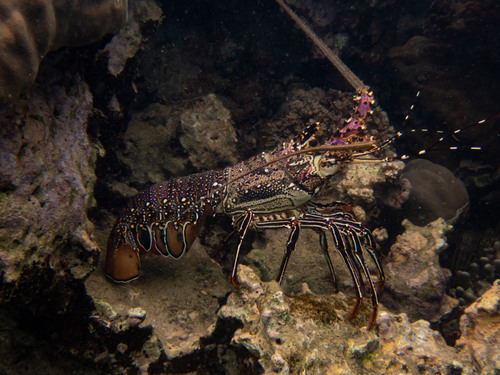
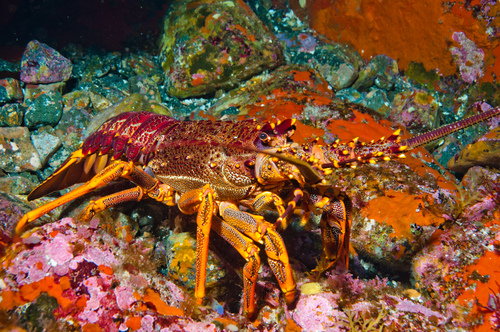
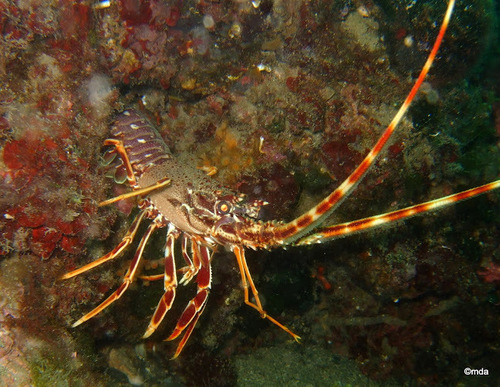
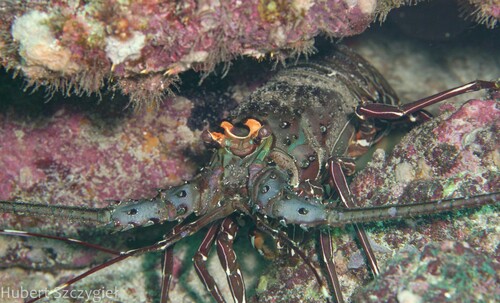
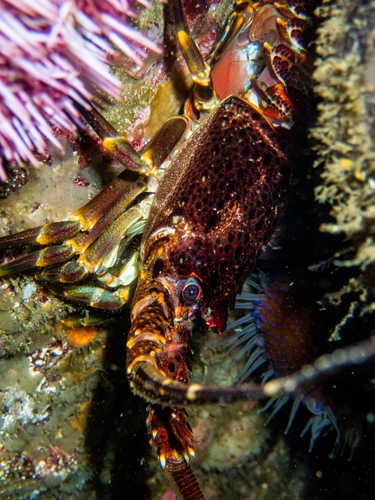
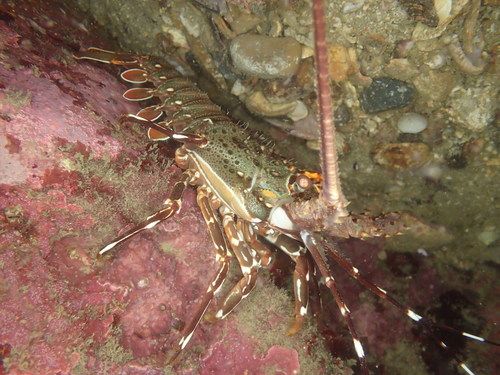
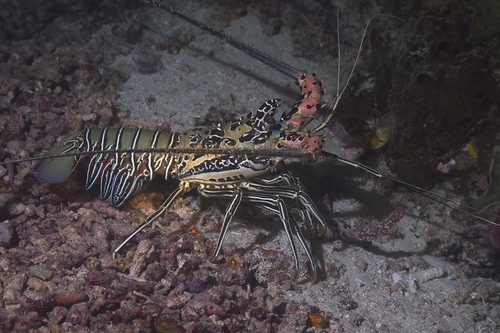
Panulirus versicolor, a species of spiny lobster, can reach a maximum length of 40 centimetres (16 inches), though most individuals do not exceed 30 centimetres (12 inches). Like all spiny lobsters, it has no claws, two spiny rostra above the eyes, and two pairs of large antennae. The first pair of antennae are double-ended, and the second pair are hard and spiny; both pairs are usually white. Its carapace is cylindrical, composed of chitin, very solid, and cannot extend. Its overall coloration combines white, pink, and black, with horizontal bands and a reticulated pattern. The abdomen is green with transverse black and white bands. The legs range from dark blue to black with white stripes, and the tail is blue-green. The tail has five yellowish appendages that are yellowish at the base, with a blue apical area and a white margin. Juvenile P. versicolor have bright blue coloration with white lines, and the base of their antennae is white rather than pink. This species is closely similar in appearance to Panulirus femoristriga and Panulirus longipes. Panulirus versicolor is native to the western Pacific Ocean and the Indian Ocean. In the Indian Ocean, its range extends from Natal on the southeastern coast of Africa, north through the Red Sea and Persian Gulf, across the Arabian Sea to India, Myanmar, Thailand, and Malaysia, and south through Indonesia to the waters of north-western Australia. In the western and central Pacific, it occurs as far north as southern Japan, throughout Micronesia, Melanesia, Polynesia, and in the waters of north-eastern Australia. A single individual of P. versicolor was recorded in the shallow coastal waters of Georgia, United States, in 2012. This specimen, the first reported from the United States and the Atlantic Ocean, was likely either deliberately released as an adult or unintentionally transported as a larva in a cargo ship's ballast water. This species inhabits shallow tropical waters, in coral reef ecosystems and on the seaward edges of reef plateaus, at depths up to 15 metres (49 ft). Panulirus versicolor is heavily targeted by commercial fishing, which has caused it to become rare or even locally extinct in many areas. Due to its large range that includes many protected areas, the species is not considered globally threatened. It is harvested for food throughout its native range, and it is also kept in home aquariums.