About Panulirus penicillatus (Olivier, 1791)
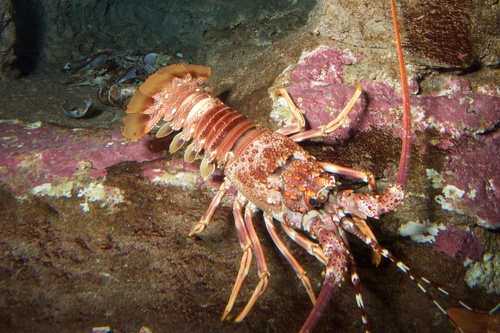
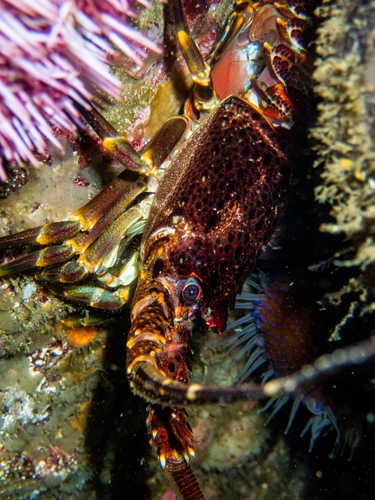
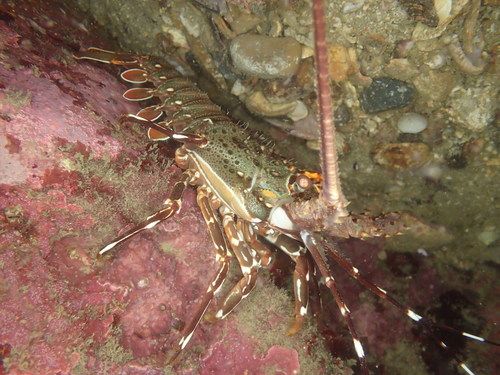
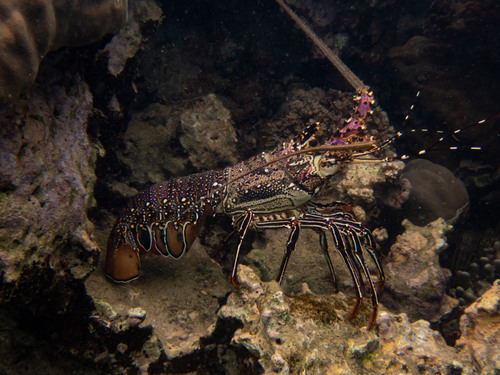
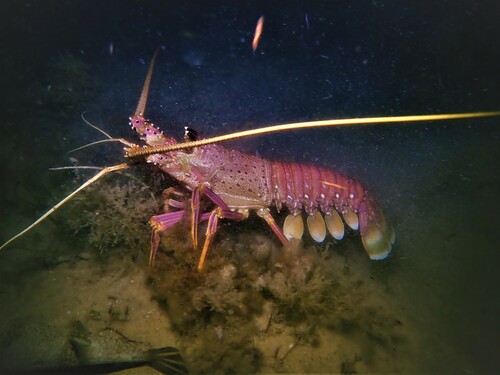
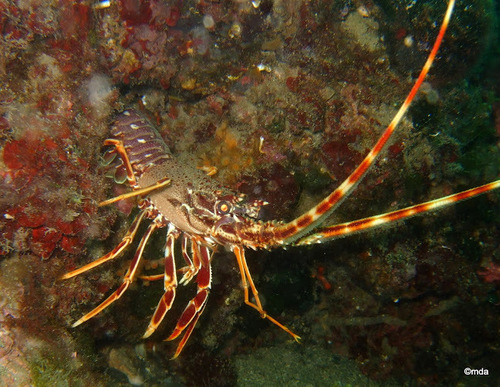
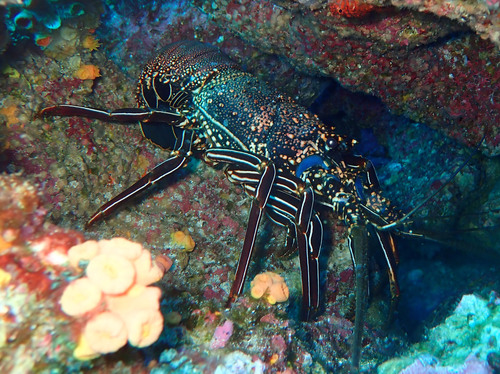
Spiny lobsters differ from true lobsters by having large spiny antennae and no pincers on their front legs. Panulirus penicillatus reaches a maximum total length of around 40 centimetres (16 inches), with a more typical adult length of 30 centimetres (12 inches); males grow larger than females. On the plate directly in front of the carapace, where the antennules attach, there is a cluster of four strong spines that are joined at their base. The colour of this spiny lobster is variable, ranging from yellowish-green to rusty-brown or bluish-black. Small white spots are present across the carapace and abdomen, and there is a pair of larger white spots near the outer edge of the first abdominal segment. Its legs are dark green or red, marked with yellow longitudinal stripes, and its antennules are not banded. Panulirus penicillatus is found in tropical and subtropical regions of the Indian and Pacific Oceans. Its distribution ranges from the eastern coast of Africa and the Red Sea to Thailand, Japan, Australia, Pacific archipelagos, the Galapagos Islands, and islands off the coast of Mexico. It inhabits shallow water, usually at depths less than 4 metres (13 ft), where it occurs on rocky surfaces, outer reef slopes, and in water channels. During the day, it hides in crevices, and emerges to be active at night.