About Panulirus interruptus (J.W.Randall, 1840)
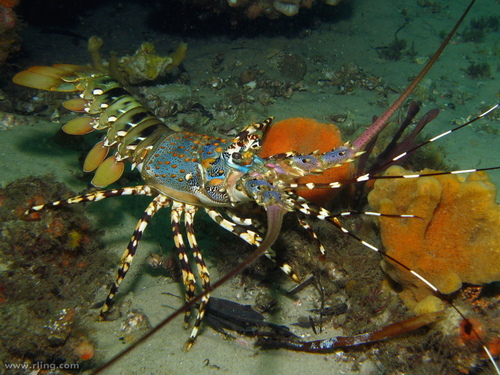
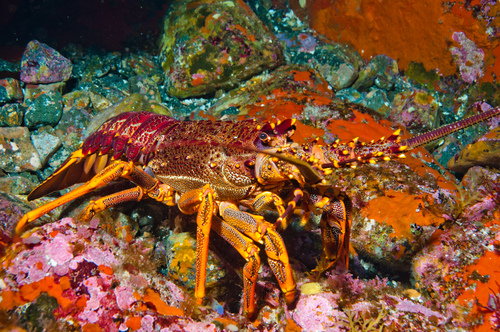
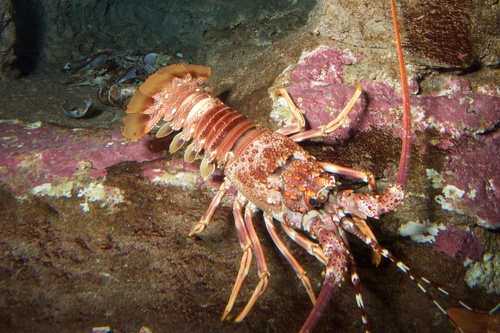
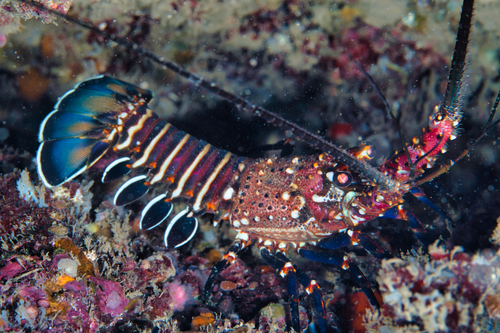
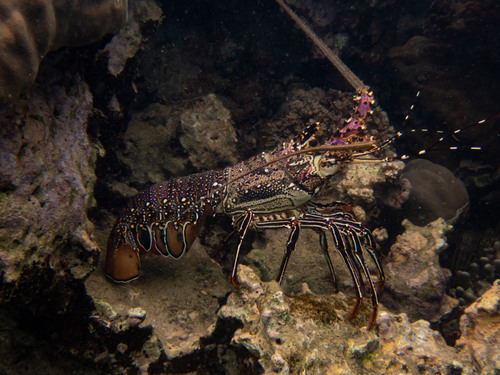
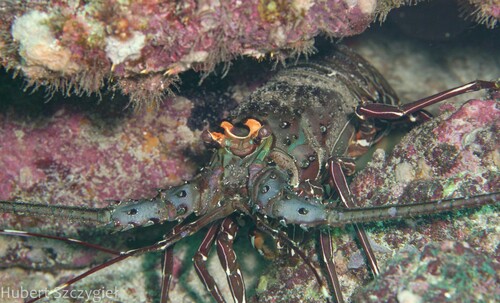
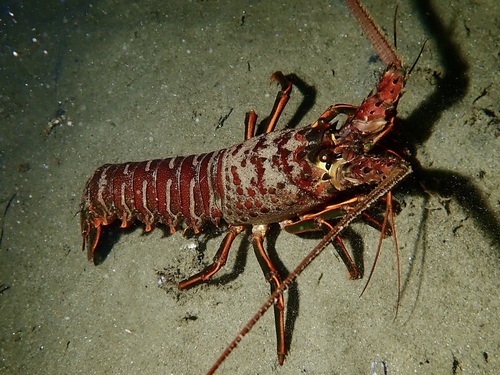
Like all spiny lobsters, Panulirus interruptus, commonly called the California spiny lobster, has two large spiny antennae, and lacks large claws on its legs. It is one of the largest spiny lobster species, growing to a maximum length of 60 centimeters (24 inches), though most individuals do not exceed 30 cm (12 in). Males can reach a weight of up to 7.4 kilograms (16 pounds); the heaviest recorded individual was a 16 pound 1 ounce male caught off Catalina Island in 1968. Its upper side is brownish red, with none of the paler bands or spots that mark some other spiny lobster species. Its legs match the body's brownish red color, but have one or more lighter streaks running along their length. Males and females of all ages can be distinguished by the position of their two round genital openings, called gonopores: in females, the gonopores sit at the bases of the third pair of pereiopods, while in males they are at the base of the fifth (last) pereiopods, furthest from the head and closest to the abdomen. Mature females have a small claw on their fifth pereiopod, plus enlarged pleopods.
The California spiny lobster is found in parts of the Gulf of California, along the entire Pacific coast of the Baja California peninsula, and extends north as far as San Luis Obispo Bay, California. There are occasional records of the species from Monterey Bay, but the water there is too cold for California spiny lobsters to breed; it is thought any adults found in Central California arrived as larvae during El Niño years. California spiny lobsters inhabit rocky substrates at depths up to 65 meters (213 feet). While adults can be found in shallow water including tide pools, they are most common in deeper waters. Juveniles generally live in rocky habitats 0–4 m (0–13 ft) deep with dense plant cover, especially the surf grass Phyllospadix torreyi.
California spiny lobsters are nocturnal. They hide in crevices during the day, with only the tips of their long antennae visible, to avoid predators. Near dawn, they form aggregations that they stay in until dusk. At night, they emerge to feed on sea urchins, clams, mussels and worms. This feeding activity is important for limiting sea urchin populations, and thus helps maintain healthy seabed communities. Natural predators of the California spiny lobster include bony fish such as California sheephead, giant sea bass and cabezone, sharks including the horn shark and leopard shark, octopuses, and sea otters. When a predator approaches, California spiny lobsters (like other spiny lobsters) can produce a loud noise via the stick-slip phenomenon, similar to the sound made by a bowed string instrument. The bases of the antennae act as a plectrum, rubbed against a file-like structure on the edge of the antennular plate. If a predator gets very close, spiny lobsters flex their muscular tail to escape backwards away from the threat. The species performs an annual migration: lobsters move into shallower water in spring and summer, and travel to deeper water in fall and winter, reaching depths as great as 73 m (240 ft), possibly to avoid the effects of winter storms.
Female California spiny lobsters reach sexual maturity when they grow to 65–69 millimeters (2.6–2.7 in) in length, which typically occurs when they are 5–9 years old; males reach sexual maturity at 3–6 years of age. Because all hard parts are shed during each molt, the lifespan of mature spiny lobsters is not certain, but they are thought to live 50 years or more. Unlike clawed lobsters and crabs, spiny lobsters do not have specialized gonopods (modified first pleopods for reproduction), and females do not have a deep sternal pocket to store sperm. Instead, a spermatophore is transferred directly from one of the male's gonopores to the female's sternum. The male gonopore has a straight, serrated "penile process" with a small "hairbrush" tip. The sternum of mature females has three "windows" on the last three segments; unlike in other Panulirus species, these windows span both halves of the sternum. These windows are softer than the rest of the exoskeleton, and are thought to help the male find the correct spot to deposit the tar-like spermatophore. After mating, fertilized eggs are carried on the female's pleopods until hatching; a single female carries between 120,000 and 680,000 eggs. The eggs start out coral red, and darken to deep maroon as they develop. A female carrying eggs is called "berried". Eggs are ready to hatch after 10 weeks, and spawning occurs from May to August. The newly hatched larvae, called phyllosoma larvae, do not resemble adult lobsters. They are flat, transparent animals around 14 mm (0.55 in) long, and as thin as a sheet of paper. The larvae feed on plankton, and grow through ten molts into ten further larval stages; the final larval stage is around 30–32 mm (1.2–1.3 in) long. The full sequence of larval molts takes approximately 7 months. When the last larval stage molts, it metamorphoses into the puerulus, the final transparent larval stage. Puerulus larvae settle to the sea floor when the water is near its maximum temperature, which falls in the fall in Baja California. Juveniles have a varied diet, consisting mostly of amphipods and isopods, along with coralline algae and the plant Phyllospadix. When crabs are available, juveniles prefer to eat them.