About Panulirus guttatus (Latreille, 1804)
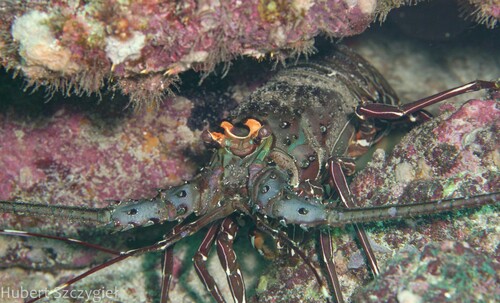
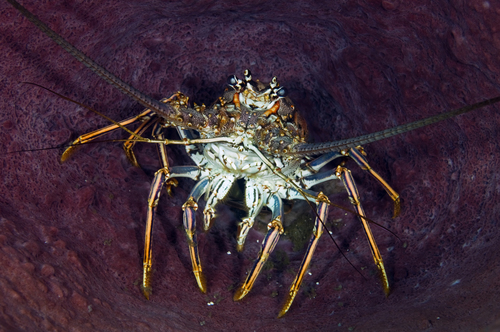
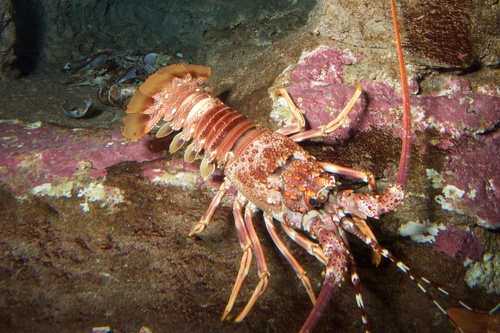
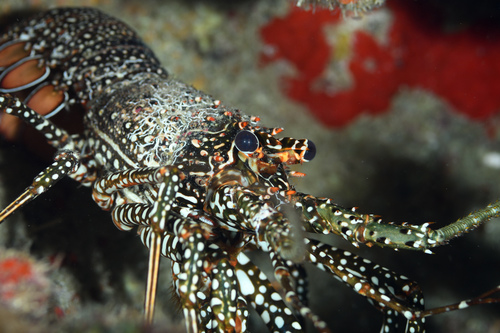
Panulirus guttatus, the spotted spiny lobster, has a pair of compound eyes mounted on flexible stalks, long thick spiny antennae, six pairs of small appendages surrounding the mouth, and five pairs of walking legs that do not end in large claws. Its antennular plate has two large, widely separated spines. The maximum total body length of this spiny lobster reaches about 20 cm (8 in), while a more typical adult length is 15 cm (6 in). Its body base color is purplish-black, and it is heavily marked with prominent round white spots. The main segments of its legs are dark with white spots, but the penultimate leg segments have dark longitudinal stripes over a pale background. This species is native to the tropical western Atlantic Ocean and the Caribbean Sea, and its range also extends into the Gulf of Mexico. It occurs from Bermuda, the Bahamas, southern Florida and the West Indies, south to Curaçao, Bonaire, Los Roques and Suriname. It inhabits rocky reefs in shallow water, found at depths down to approximately 23 metres (75 ft), and often hides in crevices or under large coral heads. During the day, it stays within the coral reef, and at night it moves away from these protected areas to feed on the ocean floor. Panulirus guttatus is a nocturnal feeder that preys on bivalve molluscs, gastropod molluscs, crustaceans and chitons, locating its food through touch and chemical cues. In Bermuda, its breeding season runs from May to October, while in the warmer regions of its range, this species breeds year-round. After mating, the female carries her eggs on her abdomen, held under her tail. When the eggs are ready to be released, the female migrates to the reef crest; moulting usually occurs after egg release. The larvae have a very long developmental period, starting as planktonic organisms, before developing into "pueruli" larvae, the transitional phase between planktonic larvae and benthic juveniles. Pueruli larvae settle on the outermost shallow reef edges where water movement is vigorous. There is no targeted commercial fishery for this species, but it is caught incidentally when fishermen target other species, caught by hand, with spears or in traps. Most individuals caught are marketed locally and eaten fresh.