About Panterpe insignis Cabanis & Heine, 1860
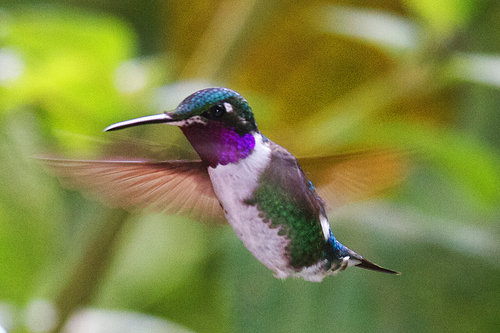
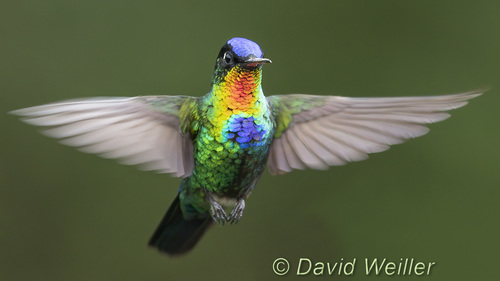
The fiery-throated hummingbird, with the scientific name Panterpe insignis Cabanis & Heine, 1860, measures 10.5 to 11 cm (4.1 to 4.3 in) in total length. Males weigh 5.9 to 6.2 g (0.21 to 0.22 oz), while females weigh 4.9 to 5.2 g (0.17 to 0.18 oz). Males and females of the same subspecies have identical plumage. All individuals of the species have a mostly black bill, with a pink base to the lower mandible, and a small white spot behind the eye. The nominate subspecies P. i. insignis has a glittering royal blue crown, with the rest of the face and nape colored black. Its back is bright metallic green, which shifts to bluish green on the uppertail coverts, and its tail is blue-black. The center of its throat is a brilliant rosy coppery orange, and the sides of the throat are golden green. It has a violet-blue patch on the center of the breast, and the rest of its underparts range from bright green to blue-green. Subspecies P. i. eisenmanni is slightly smaller than the nominate subspecies, but has a much shorter bill. Its black neck plumage extends onto the upper back, and the blue-violet plumage of its chest extends into the belly. Its uppertail coverts are mostly blue. The nominate subspecies of fiery-throated hummingbird is distributed from the Cordillera de Tilarán in north-central Costa Rica, southeast to the Bocas del Toro and Chiriquí provinces of far western Panama. P. i. eisenmanni is only found in the Cordillera de Guanacaste in northwestern Costa Rica. This hummingbird species lives in a variety of wooded landscapes, including montane forest, cloudforest, and elfin forest. It also occurs in more open landscapes such as the lower edge of páramo, secondary forest, and tree-dense pastures. It mostly stays in the forest canopy, but can also be found in low shrubs at forest edges and in clearings. In northern and north-central Costa Rica, it occurs at elevations from 1,600 m (5,250 ft) up to mountain summits of 2,000 m (6,560 ft). Further south in higher mountains, its elevational range is between 2,200 and 3,200 m (7,220 and 10,500 ft).