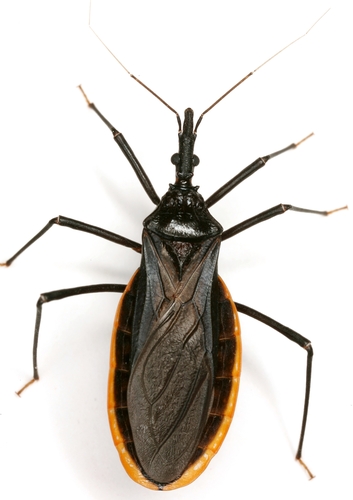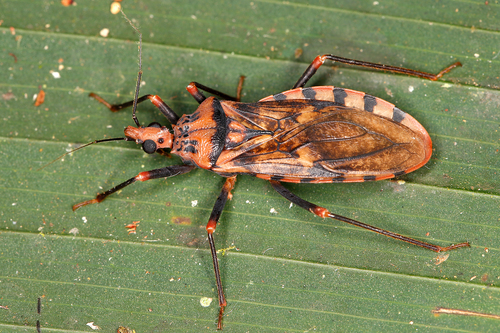
About Panstrongylus geniculatus (Latreille, 1811)
Panstrongylus geniculatus (Latreille, 1811) is a blood-feeding wild (sylvatic) insect. It is considered a putative vector of minor importance for transmitting Trypanosoma cruzi, the parasite that causes Chagas disease, to humans. This species is primarily sylvatic, living mainly in humid forests, and it also occupies vertebrate nesting sites such as those of armadillos (genus Dasypus, including nine-banded armadillos Dasypus novemcinctus). It participates in the enzootic transmission of T. cruzi to these vertebrate species, and has a wide distribution across 16 Latin American countries. Few scientific studies have focused on this species, due to the low number of collected specimens and the difficulties of rearing and maintaining populations in laboratory settings. Currently, however, P. geniculatus is gaining attention as a potential vector of Chagas disease (also called American trypanosomiasis). This is because there have been reports of the species invading domestic and peridomestic habitats across a large region covering Venezuela, Colombia, Brazil, Peru, Ecuador, and Argentina. P. geniculatus appears to be in the process of domiciliation (adapting to live in human-associated environments), using the same strategies as highly domesticated triatomine species such as Triatoma infestans and Rhodnius prolixus. This process is also seen in other wild triatomine species (subfamily Triatominae), which face similar ecological pressures caused by human disruption of their natural habitats.