About Panorpa communis Linnaeus, 1758
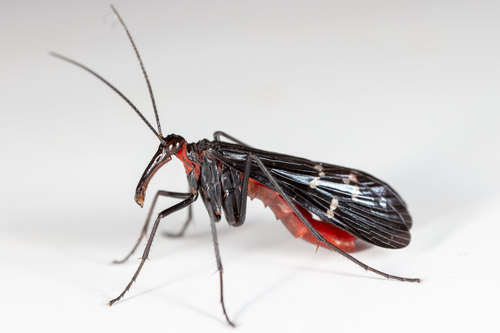
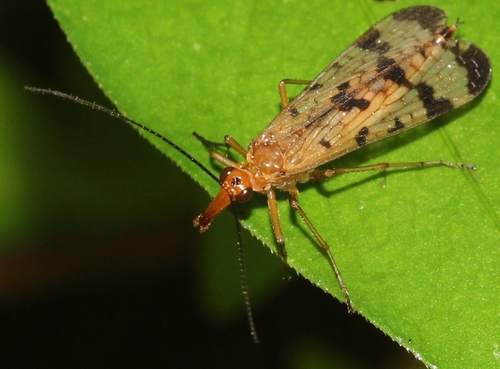
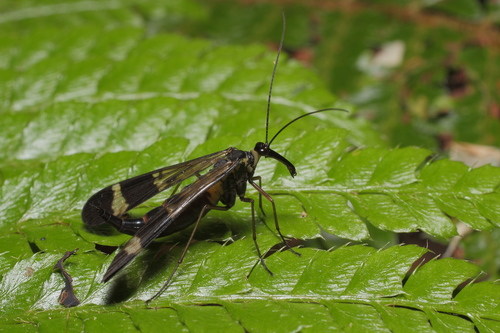
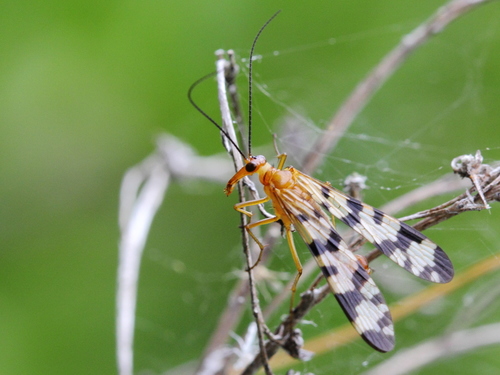
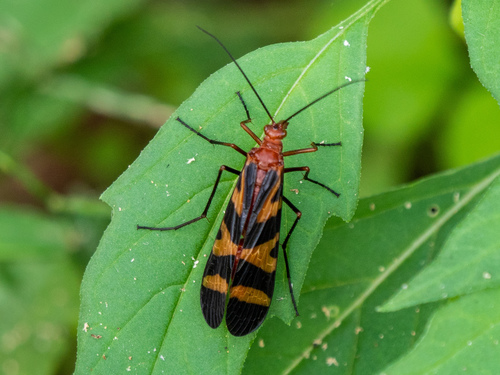
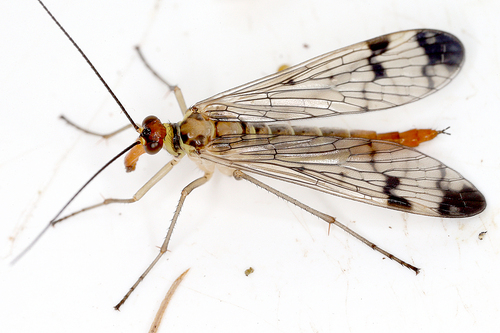
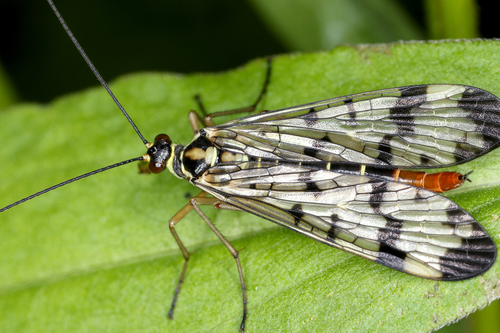
Panorpa communis, the common scorpionfly, can reach an adult body length of about 30 millimetres (1.2 in). This species has a black and yellow body, with a reddish head and tail. Males have a pair of claspers at the end of the tail, used to hold females during mating. This structure gives the insect a scorpion-like appearance, though it is not a stinger. Adult common scorpionflies have a wingspan of about 35 millimetres (1.4 in). Their wings are mostly clear, marked with many dark spots or patches. The head bears large eyes and is extended into a prominent, downward-pointing beak that opens at the tip of the head. Females are longer, heavier, and have longer legs than males. In females, the eighth abdominal segment is the shortest, almost half the length of the seventh segment; the sixth abdominal segment narrows toward the back. The larva of Panorpa communis resembles a caterpillar and grows up to 20 millimetres (0.79 in) long. It has three pairs of thoracic legs and eight pairs of prolegs. This species is native to Europe (including Italy, Switzerland, Germany, Austria, Czech Republic, Hungary, Slovakia, Ukraine, and European Russia) and Northern Asia. Common scorpionflies are usually found in hedgerows and patches of nettle.