About Panopea zelandica Quoy & Gaimard, 1835
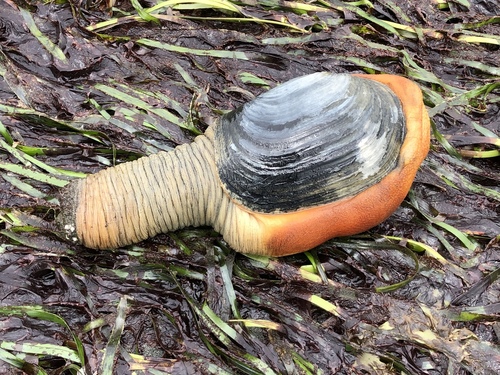
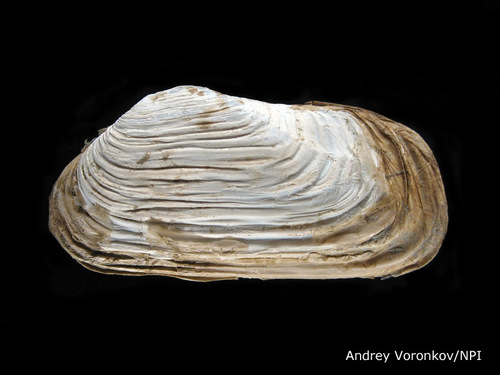
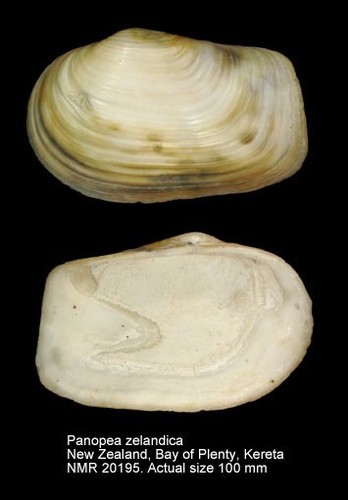
Panopea zelandica, described by Quoy & Gaimard in 1835, is a large species of marine bivalve mollusc. It is commonly called the deepwater clam or New Zealand geoduck, and is sometimes also known as king clam or gaper – the name gaper refers to its shell that cannot close at either end. It belongs to the geoduck genus Panopea, which is in the family Hiatellidae. This species is found around New Zealand’s North, South, and Stewart Islands. It occurs mainly in shallow waters between 5 and 25 metres (16 to 82 ft) deep, in sand and mud off sandy ocean beaches. It can also be found on mudflats, and has higher population density around 15 metres (49 ft) deep. A different geoduck species, Panopea smithae, inhabits deeper New Zealand waters. Like other geoducks, P. zelandica burrows downward into mud and extends a 30–45 centimetre (12–18 in) siphon up to the substrate surface. Its siphon holds two separate tubes: water is drawn into the clam through one tube, filtered to extract food, then expelled through the other tube. It is a temperate species, so average water temperature is critical for its survival; the average water temperature of its habitat ranges from 11–19 °C (52–66 °F). Geoducks are broadcast spawners, and P. zelandica practices dribble spawning. Females release eggs in batches during a single spawning period, and sperm is released into the water column at the same time eggs are released. Spawning is triggered by temperature change, and typically occurs during warmer months. Unlike the related species Panopea abrupta and Panopea generosa, which produce 2–10 million eggs over their lifetime, P. zelandica produces only around 2 million total eggs in its lifetime, with around 2 million eggs released in a single spawning period. Females have large ovaries that sit between the two halves of their shell. Most released eggs do not reach maturity, so the ratio of released eggs and sperm to fully grown adult geoducks is low.