About Pangshura tecta (Gray, 1831)
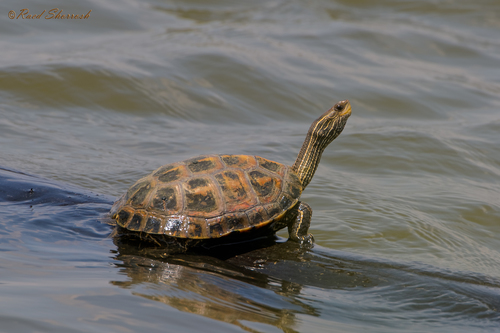
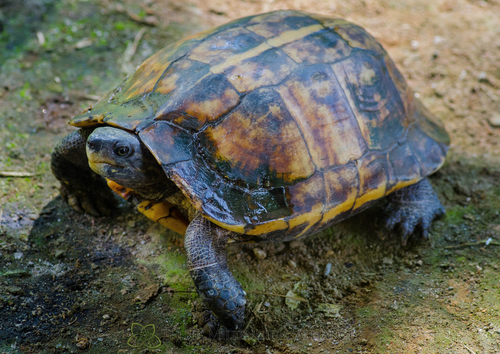
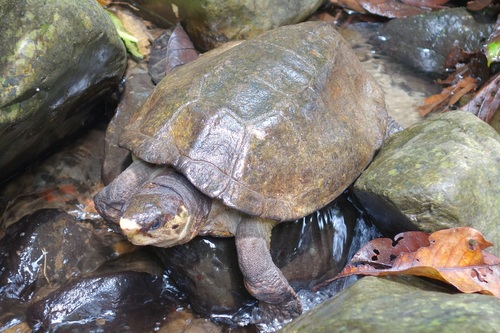
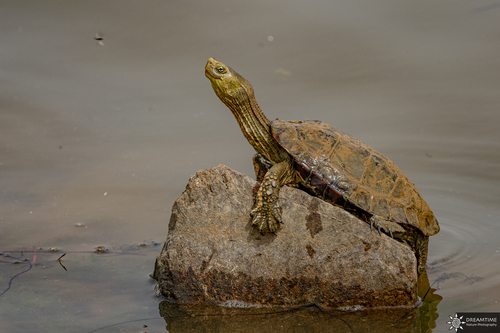
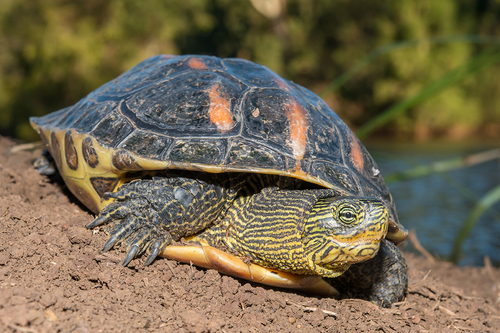
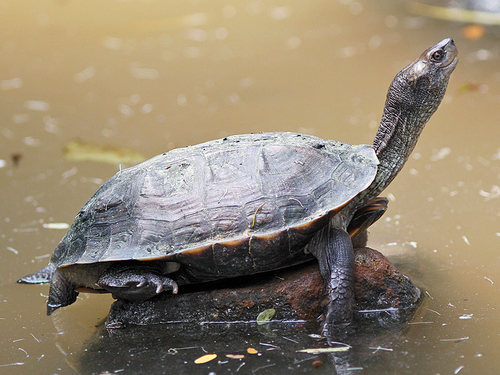
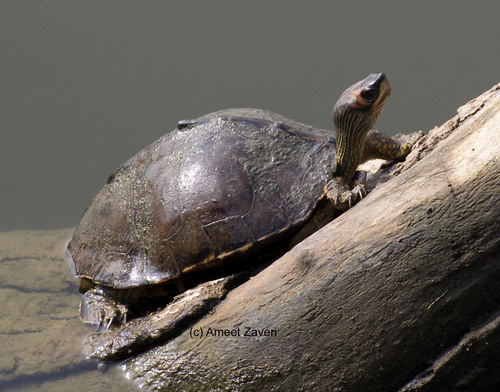
This section describes the physical characteristics of Pangshura tecta. The carapace is elevated and tectiform, with a keel that ends in a nodosity on the third vertebral shield. Its posterior margin has no or very slight serration. The nuchal shield is small, and either square or trapezoidal. The first vertebral shield is very variable in shape: in half-grown specimens, it usually has straight lateral borders that diverge toward the front, while in adults it is narrower at the front and has sinuous lateral borders. The second vertebral shield is as long as, or a little longer than, the first, and is frequently obtusely pointed at the rear. The third vertebral shield is pointed at the rear, and makes contact with the point of the very elongate fourth vertebral shield. The fifth vertebral shield is broader than all of the other vertebral shields. The plastron is large. In young individuals, it is strongly angled along the sides; it is truncate at the front, and has an angular notch at the rear. The proportions of the plastral shields are very variable. The suture between the gular and humeral shields forms a right angle, and the axillary and inguinal shields are large. The head is moderate in size. The snout is short, rather pointed, and prominent. The edges of the jaws are denticulated, and the upper jaw has no medial notch. On the alveolar surface of the upper jaw, the median ridge sits closer to the inner border than the outer border. The bony choanae are located between the orbits. The width of the lower jaw at the symphysis is less than the diameter of the orbit. The fore limbs have large transverse scales. The carapace is olive. Young individuals have some black spots on the carapace, especially along the posterior edge of the first three vertebral shields; they also have an orange vertebral band and a narrow yellow margin. The carapace is more uniform in color in adults. The plastron is orange or red with black spots, or brown with a yellowish border along the anterior and lateral edges of each shield; one recorded specimen had a uniformly yellow plastron. The head is blackish. The jaws and sides of the crown are orange. The neck has numerous yellow lines over a blackish base color. The limbs are dark olive, with yellow spots. The maximum shell length of this species is nearly 9 inches. Pangshura tecta is a quiet-water turtle. It occurs in quiet streams, canals, oxbows, ponds, and man-made water tanks, and also lives in brackish coastal waters. It prefers habitats with a soft bottom and abundant aquatic vegetation. It enjoys basking in early morning sun; basking helps it maintain its body temperature and supports Vitamin D synthesis. Pangshura tecta is distributed across the Ganges, Brahmaputra, Indus, and Mahanadi river drainages in Pakistan, northern and peninsular India, and Bangladesh.