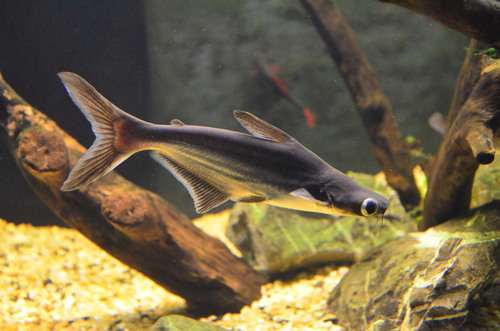
About Pangasianodon hypophthalmus (Sauvage, 1878)
Adults of Pangasianodon hypophthalmus, commonly called iridescent shark, reach up to 130 cm (4.3 ft) in length and can weigh a maximum of 44 kg (97 lb). They have a shiny, iridescent color that gives the species its common name, though large adults are uniformly grey, with dark grey or black fins. Juveniles have one black stripe along the lateral line and a second black stripe below the lateral line. This species originates from the large Chao Phraya and Mekong rivers in Asia, and has been introduced to other rivers for aquaculture. It is a freshwater fish native to tropical climates, and prefers water with a pH of 6.5–7.5, a water hardness of 2.0–29 dGH, and a temperature range of 22–26 °C (72–79 °F). Iridescent sharks can tolerate hypoxic conditions because their swim bladder can act as an air-breathing organ. They prefer large bodies of water, similar to the deep waters of their native Mekong river basin. Iridescent sharks are migratory fish. In most regions, they move upstream to spawn during the flood season when waters are high, and return downstream to find rearing habitats when river water levels recede. Migration dates vary by river system. In the Mekong river basin, they migrate upstream from May to July, and return downstream from September through December. South of the Khone Falls, upstream migration occurs from October to February, peaking from November to December, and this migration appears to be triggered by receding waters at the end of the flood season. In August 2015, an environmental group in Santander, Colombia confirmed that iridescent sharks had been found in a tributary feeding into the Magdalena River, having been accidentally introduced from local illegal farm fisheries. This discovery caused alarm among the scientific community and government officials, because the Magdalena River hosts over 200 native fish species, 35 of which are endangered. Iridescent sharks face many physical stressors including shear forces, rapid decompression, blade strike and turbulence. These stressors increase injury and mortality rates for the species. These injuries are often caused by hydropower developments built to address the ongoing global climate crisis. Iridescent sharks have also been introduced to other Southeast Asian countries for food, especially Peninsular Malaysia, Singapore, Indonesia and Myanmar. In Malaysia, Singapore and Indonesia, this species is called ikan patin, where 'ikan' means fish in Malay and Indonesian. Malaysian Chinese prefer to cook these fish whole by steaming, while Malay people typically cook them with tempoyak and curry. In Thailand, this species (often called swai) is commonly found in rivers and canals that run past important Buddhist temples and other waterside locations. Swai live in large schools, sometimes alongside other fish species including spot pangasius, red-tailed tinfoil, and tinfoil barb. People do not catch fish living in these areas, and often feed them, usually bread, as an activity that is considered both merit-making and fun.

