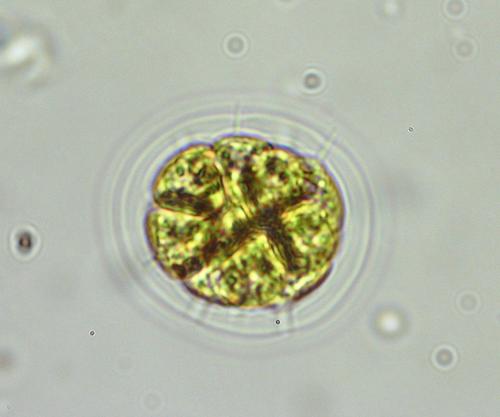
About Pandorina morum (O.F.Müll.) Bory
Pandorina morum forms subspherical colonies called coenobia that measure 20–60 μm in diameter, with individual cells ranging from 8–17 μm in length. The entire colony is surrounded by a transparent layer of mucilage. Each coenobium contains either 8 or 16 cells, which are compressed into a dense spherical aggregate and have a conical base. Every cell bears two flagella, which are longer than the cell itself, and these flagella are arranged radially around the coenobium. An apical contractile vacuole sits directly beneath each flagellum. Each cell contains a single, cup-shaped, longitudinally striated chloroplast that has an anterior eyespot and a basal pyrenoid. The cell nucleus is positioned near the middle of the chloroplast. A closely related species, Pandorina colemaniae, differs from Pandorina morum in having chloroplasts that contain at least two pyrenoids. Several varieties have been described within Pandorina morum, but these varieties may actually represent distinct separate species.

