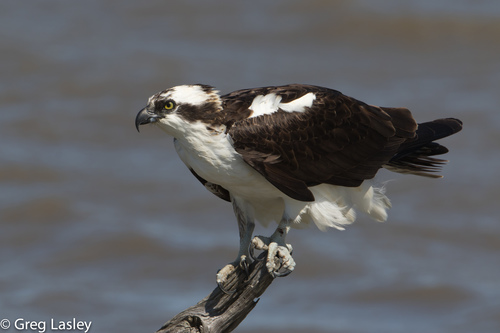
About Pandion haliaetus (Linnaeus, 1758)
This species is Pandion haliaetus, the osprey, first described by Linnaeus in 1758. Ospreys differ from other diurnal birds of prey in several key physical traits: their toes are all equal in length, their tarsi are reticulate, and their talons are rounded rather than grooved. Ospreys and owls are the only raptors with a reversible outer toe, which lets them grasp prey with two toes positioned in front and two behind. This trait is especially helpful for catching slippery fish. Adult ospreys weigh between 0.9 and 2.1 kg (2.0–4.6 lb), measure 50 to 66 cm (20–26 in) in total length, and have a wingspan of 127 to 180 cm (50–71 in), making them similar in size to the largest members of the Buteo or Falco genera. The recognized subspecies are close in size, with the nominate subspecies averaging 1.53 kg (3.4 lb), P. h. carolinensis averaging 1.7 kg (3.7 lb), and P. h. cristatus averaging 1.25 kg (2.8 lb). Measured body parts have the following size ranges: the wing chord is 38 to 52 cm (15 to 20 in), the tail is 16.5 to 24 cm (6.5 to 9.4 in), and the tarsus is 5.2 to 6.6 cm (2.0 to 2.6 in). The osprey's upperparts are a deep glossy brown; its breast is white, sometimes streaked with brown, while the underparts are solid white. Its head is white with a dark eye mask that extends to the sides of the neck. The irises range from golden to brown, and the transparent nictitating membrane is pale blue. The bill is black with a blue cere, and the feet are white with black talons. Black wrist markings on the underside of the wings act as a useful field mark. A short tail and long, narrow wings with four long finger-like primary feathers and a shorter fifth feather give the osprey a very distinctive silhouette. The sexes look broadly similar, but adult males can be distinguished by slimmer bodies, narrower wings, a weaker or absent brown breast band, and more uniformly pale underwing coverts. Sexing is straightforward for breeding pairs, but more difficult for individual unpaired birds. Juvenile ospreys can be identified by buff fringes along the edges of their upperpart plumage, a buff tone to their underparts, and streaked head feathers. In spring, after upperpart plumage has worn over time, barring on the underwings and flight feathers is a more reliable indicator of a young bird. In flight, ospreys hold their wings arched with drooping wingtips, giving them a gull-like appearance. Their call is a series of sharp whistles, typically described as cheep, cheep or yewk, yewk. When disturbed near the nest, they produce a frenzied cheereek call. The osprey is the second most widely distributed raptor species worldwide, after the peregrine falcon, and is one of only six land bird species with a global distribution. It occurs in temperate and tropical regions of every continent except Antarctica. In North America, it breeds from Alaska and Newfoundland south to the Gulf Coast and Florida, and winters further south from the southern United States through to Argentina. In Europe, it is present through the summer months as far north as Ireland, Scandinavia, Finland and Great Britain, though it is not found in Iceland, and winters in North Africa. In Australia, most ospreys are sedentary and found in patchy coastal populations; they are non-breeding visitors to eastern Victoria and Tasmania. There is a 1,000 km (620 mi) gap in breeding distribution along the coast of the Nullarbor Plain, between the westernmost breeding site in South Australia and the nearest breeding sites to the west in Western Australia. On Pacific islands, ospreys are found in the Bismarck Islands, Solomon Islands and New Caledonia. Fossil remains of adult and juvenile ospreys have been found in Tonga, where the species was likely extirpated after humans arrived. It may have once ranged across Vanuatu and Fiji as well. Ospreys are an uncommon to fairly common winter visitor across all of South Asia, and throughout Southeast Asia from Myanmar through Indochina, southern China, Indonesia, Malaysia, and the Philippines. Ospreys breed near freshwater lakes and rivers, and sometimes on coastal brackish waters. On Rottnest Island off Western Australia, they nest on rocky outcrops just offshore; there are around 14 similar nesting sites here, with 5 to 7 used each year. Many nests are renovated each breeding season, and some have been in active use for 70 years. Nests are large heaps made of sticks, driftwood, turf, or seaweed, built in tree forks, on rocky outcrops, utility poles, artificial platforms, or offshore islets. Large nests built on utility poles can reach up to 2 meters wide and weigh around 135 kg (298 lb), and can create fire hazards that cause power outages. Generally, ospreys reach sexual maturity and begin breeding at 3 to 4 years old. In regions with high osprey densities, such as Chesapeake Bay in the United States, they may not start breeding until 5 to 7 years old, due to a shortage of suitable tall nesting structures. If no nesting sites are available, young ospreys must delay breeding. To address this shortage, people sometimes erect posts to add more usable nesting sites. A nesting platform design developed by Citizens United to Protect the Maurice River and Its Tributaries, Inc. has become the official state-recognized design for New Jersey, U.S. The platform plans and materials list, available online, have been used by people in many different geographic regions. A global website exists to map osprey nest locations and log observations of reproductive success. Ospreys usually mate for life, though rare cases of polyandry have been recorded. The timing of the breeding season changes with latitude: it falls in spring (September–October) in southern Australia, April to July in northern Australia, and winter (June–August) in southern Queensland. In spring, breeding pairs enter a five-month partnership period to raise their young. Within a month of pairing, the female lays 2 to 4 eggs. She relies on the large size of the nest to retain heat for incubating the eggs. The eggs are whitish with bold reddish-brown splotches, measure approximately 6.2 cm × 4.5 cm (2.4 in × 1.8 in), and weigh about 65 g (2.3 oz). Eggs incubate for 35 to 43 days before hatching. Newly hatched chicks weigh only 50 to 60 g (1.8–2.1 oz), but fledge 8 to 10 weeks after hatching. A study on Kangaroo Island, South Australia recorded an average of 69 days between hatching and fledging. The same study found an average of 0.66 fledged young per year per occupied territory, and 0.92 fledged young per year per active nest. Around 22% of surviving young ospreys either remained on Kangaroo Island or returned to the island at maturity to join the breeding population. When food is scarce, the earliest-hatched chicks are the most likely to survive. The typical lifespan of an osprey is 7 to 10 years, though rare individuals can live 20 to 25 years. The oldest recorded wild osprey in Europe lived to 26 years and 11 months of age.

