About Pandanus utilis Bory
Pandanus utilis Bory, commonly called common screwpine, is a species in the genus Pandanus, the largest genus in the family Pandanaceae. It is estimated that the genus Pandanus contains between 500 and 1,000 species, and the Plants of the World Online database currently accepts 562 species. This species was discovered by French naturalist Jean Baptiste Bory de Saint-Vincent in 1801–1802, and formally described in 1804. Traditionally, P. utilis was thought to originate from Madagascar, but more recent research has suggested the Mascarene Islands as a possible place of origin. A long history of cultivation and human transport across the globe makes tracing its exact origin difficult. Today, it is actively grown in Senegal, Benin, Tanzania, Madagascar, Réunion, the Maldives, and Mauritius. It has also been introduced to many other tropical and subtropical regions, including Central America, the Caribbean, southern Florida and Puerto Rico in the United States, Brazil, India, Okinawa (Japan), and Indonesia.
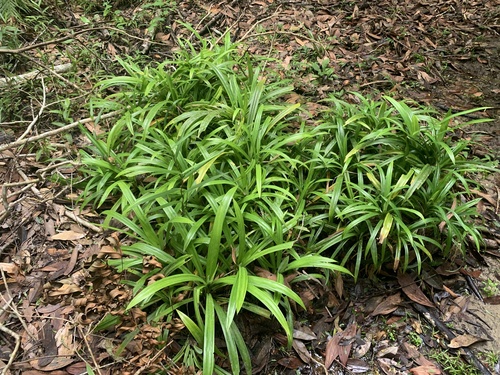
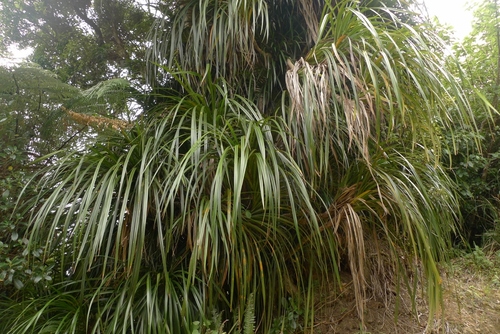
Pandanus utilis is a palm-like evergreen tree that can reach up to 20 metres (66 ft) in height. Like many species in the Pandanus genus, it produces aerial prop roots from its trunk. It has an upright, smooth trunk that develops many horizontally spreading branches marked with annular leaf scars. Old leaf scars spiral around the trunk and branches, giving the tree its common name of screwpine. The stems of all Pandanaceae can be told apart from other monocotyledons by their compound vascular bundles: these bi- or tripolar bundles hold two or three distinct conduction strands enclosed within a shared common bundle sheath. At the end of each branch, there is a spiral cluster of long, linear leaves. These leaves have pectinate (comb-like) edges that taper to a long point at the apex, and the leaf margin is lined with small reddish teeth. Leaves grow in a spiral arrangement on the tree; they are simple and unlobed, 0.5–2 m (1.6–6.6 ft) long and 6–10 cm (2.4–3.9 in) broad, with red spines along their margins. Leaves lack petioles, are broadly clasped at the base, and range in colour from blue-green to dark green. They are stiff, waxy in texture, and have parallel longitudinal venation. Their internal tissue is spongy, with numerous fibre bundles that can each contain more than 150 fibres. Like all species in the genus Pandanus, P. utilis does not produce secondary growth, the woody growth that adds structural support to the trunk of most trees. To compensate for the lack of this supportive structure, P. utilis grows many pale brown prop roots at the base of its trunk. These adventitious roots grow from the stem above the soil level, and act to anchor and support the tree, keeping it upright during heavy tropical winds and rain. These prop roots can reach 2.5 to 7.5 centimetres (0.98 to 2.95 in) in diameter.
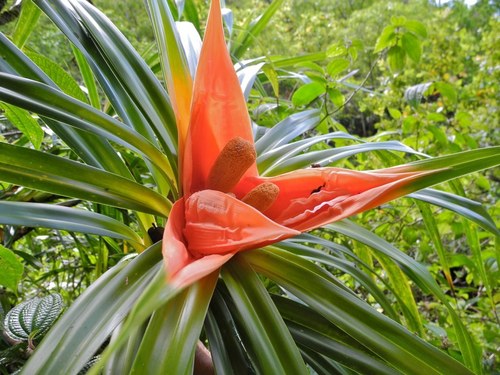
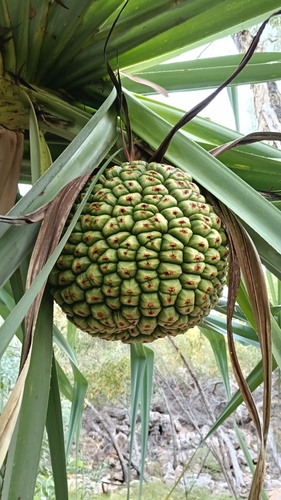
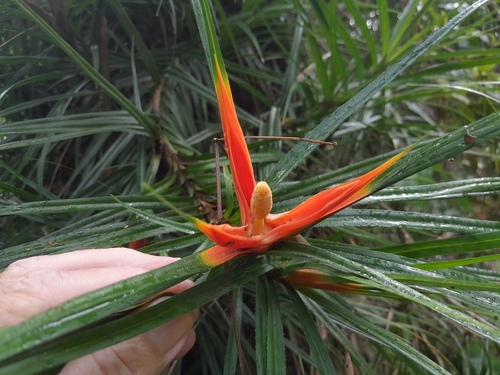
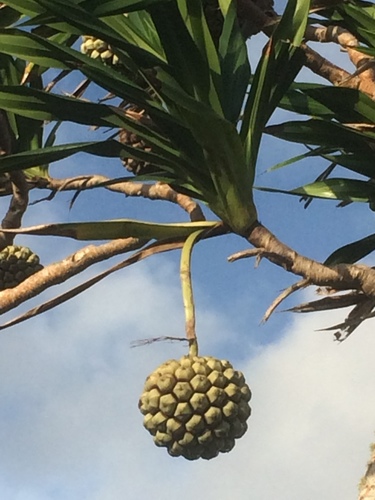
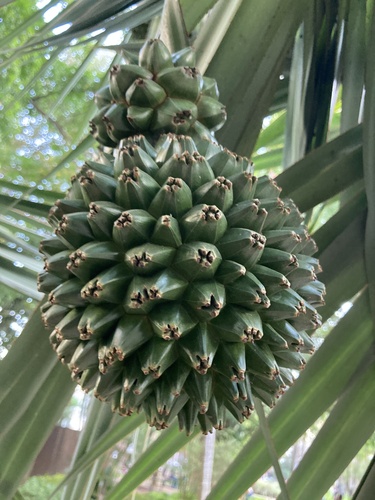
Pandanus utilis is dioecious, meaning female and male reproductive structures grow on separate individual plants: each plant is either male, producing microspores, or female, producing megaspores. This separation allows cross-fertilization between different individuals. Male plants produce fragrant creamy-white flowers arranged in long spikes; these spikes hold 8–12 stamens inserted in a pseudo-umbel on slender stalks 10 to 15 millimetres (0.39 to 0.59 in) long. Female plants produce fruit that loosely resembles an oversized pine cone, changing colour from green to yellow, orange, or reddish as it ripens. The female reproductive structure has a 3–8 celled ovary crowned by a sessile stigma. P. utilis is naturalised on several Mascarene islands, where it grows alongside other indigenous and endemic Pandanus species. It can usually be distinguished from these related species by the tip of the free portion of each drupe in its fruit-head: this tip usually does not have an areole, and is typically cleft between the stigmas. Fruit-heads are quite variable in form, but most are up to 20 cm wide and contain 100 to 200 drupes.
In ecological terms, P. utilis grows well near the sea and is salt-tolerant. It is a strictly tropical tree that cannot survive frost. It grows in conditions from full sun to partial shade, but prefers at least 6 hours of direct sunlight per day. Its seeds take two to three months to germinate.
Common screwpine has a wide range of uses. In coastal regions, it is used for erosion control, as its many aerial roots help bind sand dunes and protect them from erosion by wind and water. Its leaves are used across many cultures for thatching and to make a variety of products. Care is required when handling leaves due to their sharp spines. In Madagascar, Réunion, and Mauritius, leaves are used to make ropes, baskets, mats, hats, place mats, nets, thatched home roofs, and even paper. The natural waxy coating on leaves makes them naturally water-resistant, which makes them particularly desirable for baskets and roofs. The starchy fruit can be eaten once cooked.