About Pandanus tectorius Parkinson ex Du Roi
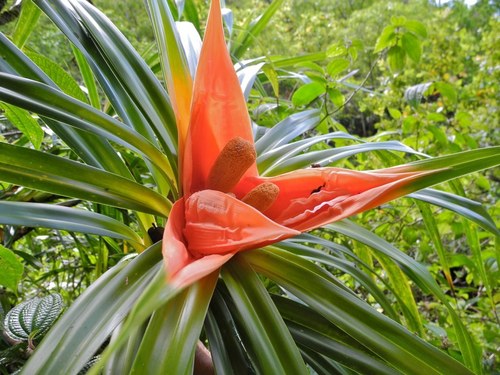
Pandanus tectorius Parkinson ex Du Roi, also called Thatch Screwpine, is a small upright tree that reaches 4–14 m (13–46 ft) in height. It has a single, slender spiny trunk with brown ringed bark; the tree grows to 4.5–11 m (15–35 ft) in width, and its trunk forks at a height of 4–8 metres (13–26 ft). The tree is supported by aerial prop roots that anchor it firmly to the ground; roots sometimes grow along branches, and grow at wide angles relative to the trunk.
This species grows natively from the Philippines through the Pacific Ocean to Hawaii. It occurs in parts of Malesia: the Cocos (Keeling) Islands, Java, the Lesser Sunda Islands, the Maluku Islands, and the Philippines. It grows throughout Papuasia, most of the tropical Pacific, and in Australia it is native to the area from Port Macquarie in New South Wales to northern Queensland. Both the US and the Hawaiian Islands recognize only one indigenous Pandanus species, P. tectorius. Its exact native range is unknown due to extensive cultivation; it may be an early Polynesian introduction to many more isolated Pacific islands where it occurs, including Micronesia and Melanesia. In Hawaii, it grows natively on all main islands except Kahoʻolawe, and seed and pollen samples from Kauaʻi's Makauwahi Cave confirm it predated human settlement there.
P. tectorius naturally grows in coastal regions such as mangrove margins and beaches, at elevations from sea level to 610 m (2,000 ft). It requires 1,500–4,000 mm (59–157 in) of annual rainfall, with alternating wet and dry seasons. It is more drought tolerant than coconut trees, and adapts to drought by reducing fruiting. It grows well in many coastal soil types, including quartz sand, coral sand, peat, limestone, and basalt. It is salt and wind tolerant, prefers slightly acidic to basic soil with a pH of 6–10, and its strong structure typically allows it to withstand tropical storms. It prefers full sunlight, grows well in 30-50% shade, and cannot tolerate shade above 70%.
A wide range of natural enemies including parasites, pathogens, and herbivores threaten P. tectorius, attacking its leaves, roots, stems, and growing points. The stick insect Megacrania batesii lives and feeds only on P. tectorius and two other Pandanus species. In Australia, P. tectorius is threatened by Jamella australiae, the Pandanus planthopper, a sap-sucking bug in the genus Jamella, subfamily Flatinae. This pest caused extensive damage to plants on the northern coast of New South Wales, then moved up the coast to Noosa and the Gold Coast in Queensland in the 1990s. It has since infested pandanus further north, killing about 80% of the P. tectorius population south of Gladstone, Queensland, and has reached Yeppoon on the Capricorn Coast, where P. tectorius plays an important role in preventing coastal erosion. A natural predator, the wasp Aphanomerus pusillus native to northern Queensland, has been introduced to Fraser Island and Byfield National Park as a control method for the planthopper. Other control methods used on Fraser Island include injecting insecticide into plants, stripping away infested leaves, and breeding new plants from local stock. The wasp can only be used during warmer months on the island, as it does not thrive in the cooler climate of southern Queensland.
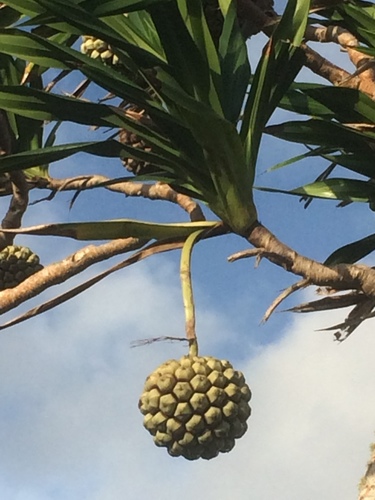
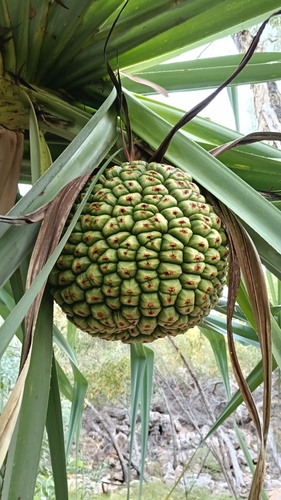
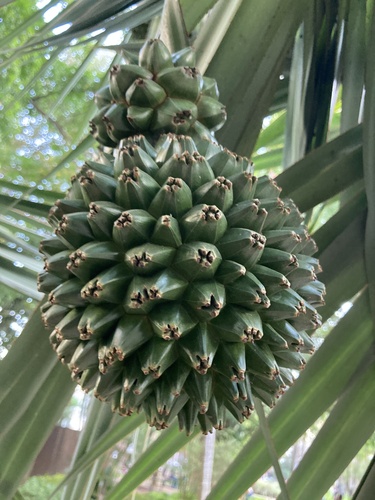
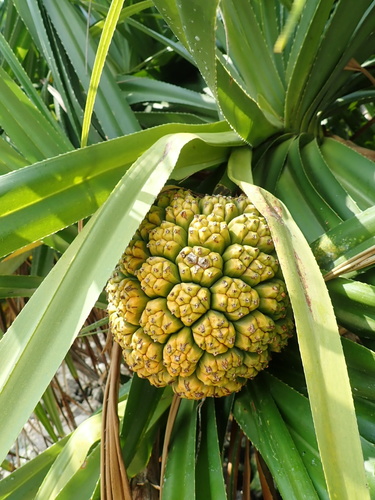
P. tectorius can be grown from seed or cuttings. Seed-grown plants flower at around 15 years of age, while cutting-grown plants usually flower by 3 to 4 years of age. Female trees typically flower one to three times per year, while male trees flower every 2 months. It is thought to reproduce sexually in Hawaii, though there is some evidence of apomixis. Pollination is usually carried out by small insects such as bees, and by wind. It takes 1 to 2 years from pollination for female trees to produce fruit, and pollination seasons vary by location and variety: in Fiji the season is March to May, in northern Australia it is April to August, and in Micronesia there are two seasons: December to March and July to September. Most varieties produce 8 to 12 fruits per tree every 2 years. Each fruit usually weighs between 7 and 15 kg (15 and 33 lb), and contains 35 to 80 edible keys.
In Hawaii, P. tectorius is usually propagated by seed. Seeds (keys) are soaked in cool tap water for 5 days with frequent water changes; viable keys float, so these are kept. Per gardener Bornhorst's guide Growing native Hawaiian plants: a how-to guide for the gardener, growers should remove the fleshy layer from the key, then bury the seed halfway in planting soil and keep the soil consistently moist. P. tectorius can also be grown from large cuttings. In Micronesia, selected forms are propagated by stem cuttings, with selection based on morphological traits including presence of aerial roots. Selected plants have two-thirds of their leaves trimmed off to prevent water loss. In Native Hawaiian plants for tropical seaside landscaping, Moriarty states the best results come from using mature branches with leaves and small aerial roots, which are then rooted in a sand bed. Cutting-grown plants produce fruit in 4 to 6 years. Propagation by grafting is not possible for this species.
P. tectorius has many human uses. Its fruit is edible; some varieties and cultivars contain significant amounts of calcium oxalate, so they require thorough cooking before consumption. Other cultivars have very little to no calcium oxalate and can be eaten raw. It is an important food source on the atolls of Micronesia and Polynesia, where the fruit is commonly eaten raw, processed into a dried paste (such as mokwan in the Marshall Islands or te tuae in Kiribati), or ground into flour. It is also one of the traditional foods of Maldivian cuisine. The fibrous fruit also works as a natural dental floss. In Samoan culture, dried fruit is used to make ula fala, a red-painted necklace worn by matai during special occasions. Australian Aboriginal peoples extracted the tree's slender edible seeds, and both the seeds and fruit were important food sources. The tree's leaves are often used to flavor sweet dishes, and are used in Sri Lankan cookery to flavor a variety of curries. Polynesians used the leaves to make baskets, mats, outrigger canoe sails, thatch roofs, and grass skirts. The fragrant male flowers are used in perfumery, and are distilled to make kewra.
This large shrub or small tree has immense cultural, health, and economic importance in the Pacific, and is second only to coconut on atolls. It grows wild mainly in semi-natural vegetation in littoral habitats throughout the tropical and subtropical Pacific, where it can withstand drought, strong winds, and salt spray. It propagates readily from seed, and is also widely propagated from branch cuttings by local people for farms and home gardens. It grows fairly quickly, and all parts of the tree are used: from the nutritious fruits of edible varieties, to poles and branches for construction, to leaves for weaving and making garlands. It features prominently in Pacific culture and tradition, including local traditional medicine. Hundreds of cultivated varieties are known by their local names, distinguished by the characteristics of their fruits, branches, and leaves. Currently, this cultivated diversity is declining, and certain varieties are becoming difficult to find. Causes of this decline include reduced replanting, deforestation, fire, waning interest from newer generations, and rapid population growth leading to urbanization.