About Pandanus spiralis R.Br.
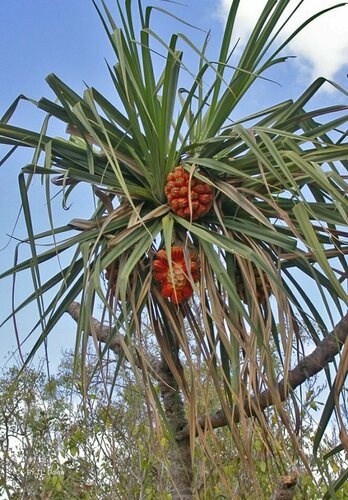
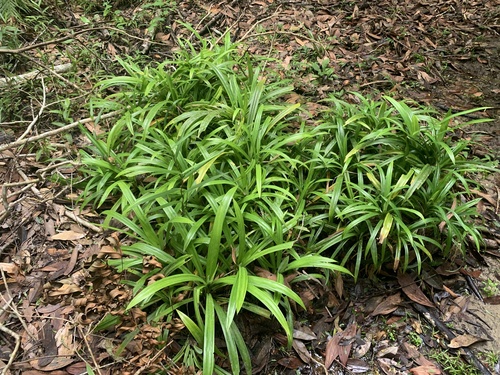
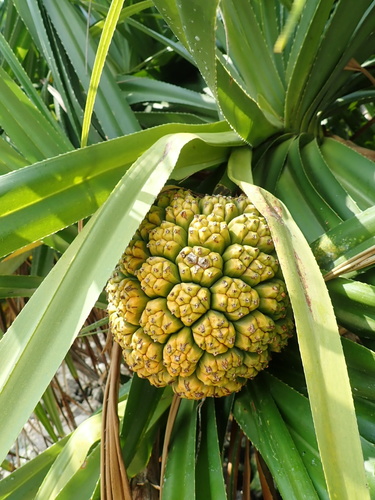
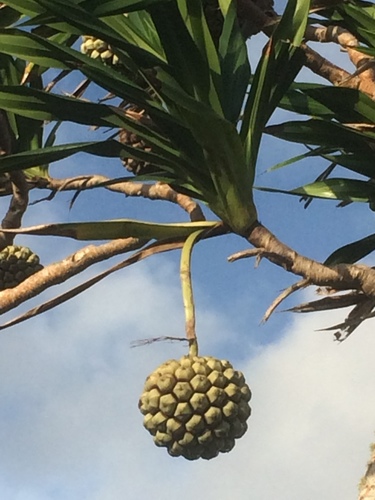
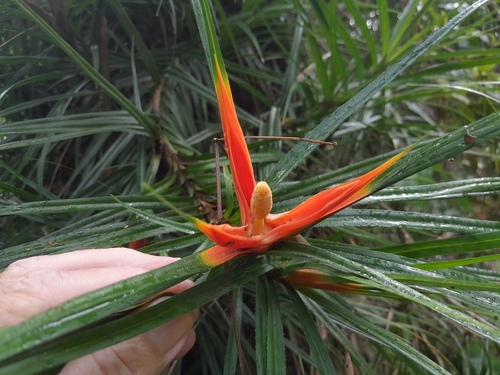
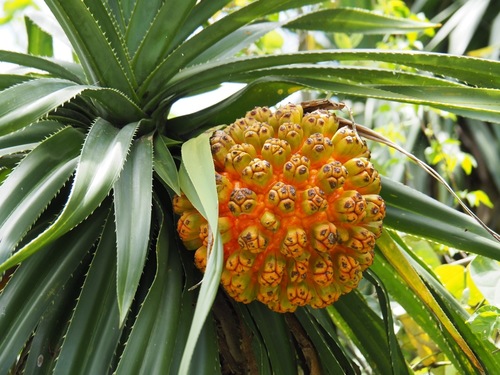
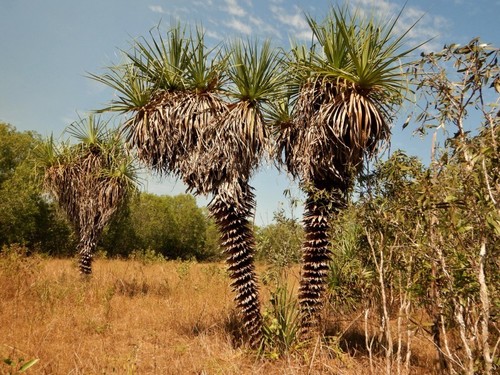
Pandanus spiralis R.Br. is a small tree that can grow up to 10 m (33 ft) tall, with a slender trunk and often a clumping growth habit. Prop roots may be present, but they are more commonly absent. Its leaves are 1–2 m (3 ft 3 in – 6 ft 7 in) long and 4–7 cm (1.6–2.8 in) wide; the leaf margins and midrib may or may not have sharp spines. Leaves are arranged spirally along the trunk and branches, and are crowded towards the tips of these structures. As leaves die, they can form a dense hanging skirt around the trunk just below the actively growing section. Lower down on the trunk, leaf bases often remain attached, creating a noticeable spiral pattern. Inflorescences grow at the end of stems: on male plants, they form a hanging string of multiple spadices, each around 5 cm (2 in) long. On female plants, the inflorescence is a single head 20–30 cm (8–12 in) long, covered by large leaf-like bracts. The fruit is a multiple fruit made up of 10–25 segments called "phalanges". Each phalange measures 8–10 cm (3.1–3.9 in) long and 5–8 cm (2.0–3.1 in) wide. Phalanges are made of dense fibrous material, with 5–7 seeds embedded inside. The fruit is green when unripe, and turns orange or red when fully ripe. This species is native to northern Queensland, the Northern Territory, and the extreme north of Western Australia. It grows in savannah woodlands and poorly drained areas, including along creeks and rivers, on floodplain margins, and on coastal dunes, across a range of substrates such as sand, alluvium, and clay. The dense skirt of dead leaves on the trunk provides shelter for many types of wildlife, including birds, bats, rodents, and lizards. Cockatoos and possums eat the seeds from the plant's fruit. The leaves of Pandanus spiralis are used to weave a variety of products, including neckbands, armbands, baskets, mats, fish traps, and shelters. Fibre can be stripped from the leaves to make string for dillybags and other items. The trunks are used to construct rafts. This plant has multiple medicinal uses: it serves as an antiseptic and analgesic, and is used to treat dysentery and diarrhoea. The white inner portion of the leaf is pounded to make an anaesthetic for tooth pain. Leaf bases are edible, and seeds can be eaten raw or roasted, or ground into flour. Fully ripe fruit are used for ceremonial purposes due to their scent.