About Pandalus montagui Leach, 1814
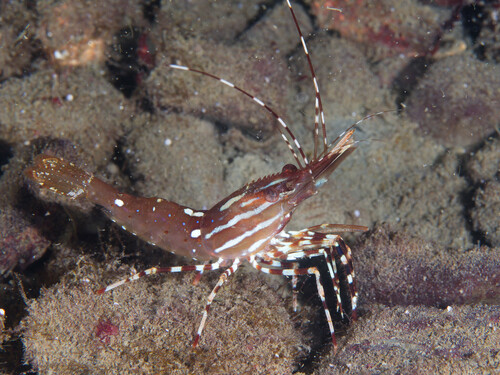
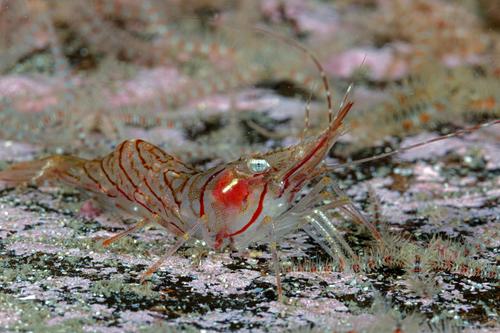
Pandalus montagui is a translucent, pinkish shrimp that typically grows to around 5 cm (2.0 inches) in length. Its pinkish color comes from a set of red chromatophores, alongside a few short red streaks that run obliquely across its carapace. It has a long, up-curved rostrum that is divided at the tip, with 10 to 12 teeth along its posterior dorsal edge. A small spine is located on the carapace beneath the eye. The first antenna is split into two sections, while the second antenna is very long – longer than the shrimp’s full body – and marked with alternating pale and dark brown bands. This species can be told apart from the closely similar P. tridens by its shorter rostrum and longer dactyls (claws) on the third and fourth pereopods (walking limbs). Pandalus montagui has a boreo-arctic distribution. Its range spans Greenland, Iceland, the Arctic Ocean, and the northern Atlantic Ocean, extending as far south as Rhode Island and the British Isles. It prefers hard substrates, but can be found living on rock, gravel, sand, and mud. It is most commonly found at depths between 20 and 100 m (66 and 328 ft), though it sometimes occurs near low-water mark or at depths as great as 700 m (2,300 ft). In the North Sea, P. montagui is often found living in association with the polychaete worm Sabellaria spinulosa. This worm sometimes forms cold-water reefs, which are an important food source for the shrimp. Fishermen use this association to locate reefs, then trawl for the shrimp in nearby waters. Also known as the Aesop shrimp, P. montagui is sometimes parasitized by the bopyrid isopod Hemiarthrus abdominalis. This isopod also parasitizes several other shrimp species, but has never been recorded parasitizing Pandalus borealis.