About Panaeolus papilionaceus (Bull.) Quél.
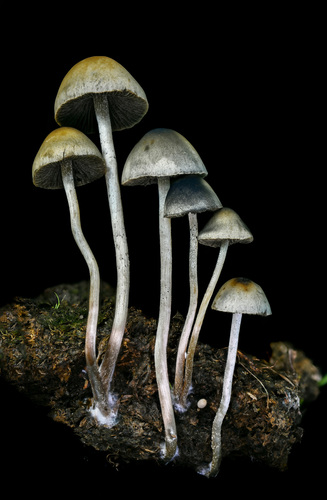
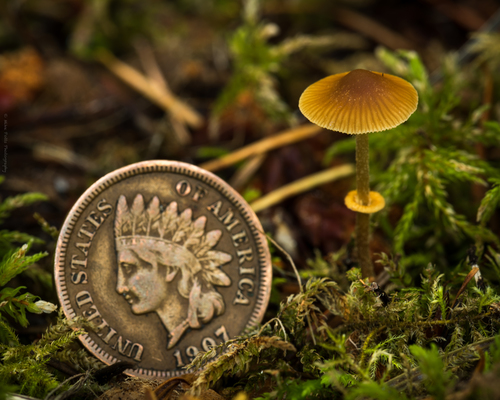
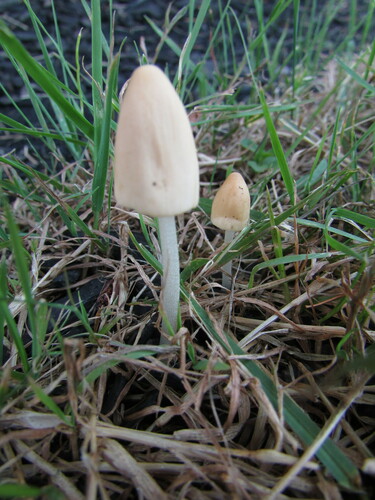
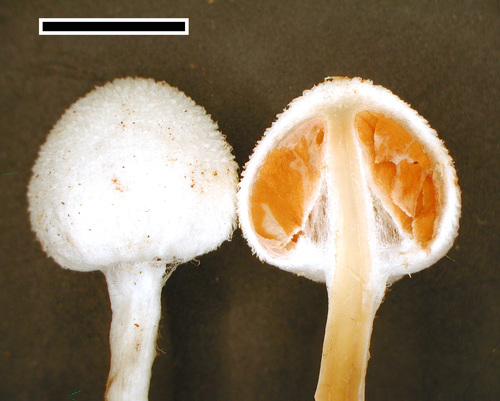
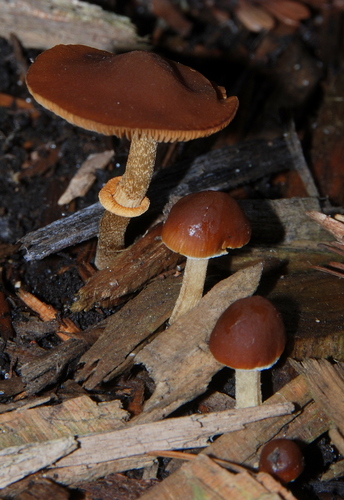
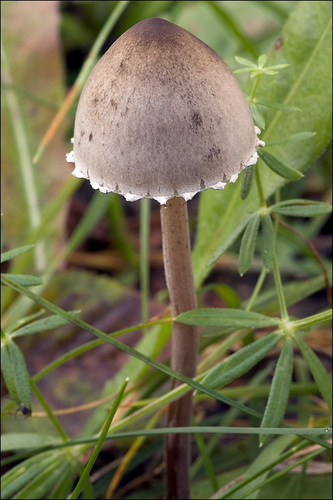
The cap of Panaeolus papilionaceus (Bull.) Quél. measures 1–5 centimetres (1⁄2–2 in) across. It starts out obtusely conic, then develops into a campanulate shape, and is grayish brown in color. The cap is not hygrophanous, and when young or towards the edge, its margin has white, toothlike fragments of the partial veil. The cap flesh is thin. The gills are adnate to adnexed, spaced close to crowded, with one or two tiers of intermediate gills. They are pale gray when young, develop a mottled, blackish appearance as they age, and have whitish edges. The spore print of this species is black. The stipe is 6–12 cm long and 2–4 mm thick, with a color ranging from gray-brown to reddish brown. It darkens in areas where it has been handled, becomes paler toward the apex, and has a brittle, fibrous texture with a pruinose surface. The mushroom has a mild odor, and an unappetizing taste. Panaeolus papilionaceus grows singly, in scattered groups, or in caespitose clusters, on cow or horse dung, moose droppings, and in pastures. It is widely distributed throughout North America, where it can be found year-round, though it only occurs in warmer climates during winter. It has been recorded in the following locations: Canada (Alberta, British Columbia), the United States (Alabama, Alaska, California, Colorado, Florida, Georgia, Indiana, Louisiana, Maine, Massachusetts, Missouri, Montana, New Mexico, New York, Oklahoma, Texas, Washington), the Caribbean (Bahamas, Cuba, San Vincent Island), Chile, Colombia, Uruguay, France, The Netherlands, Greece, Mexico, Norway, Slovenia, South Africa, Uganda, China, Iran, Lithuania, Kuwait, and the Philippines.