About Panaeolus fimicola (Pers.) Gillet
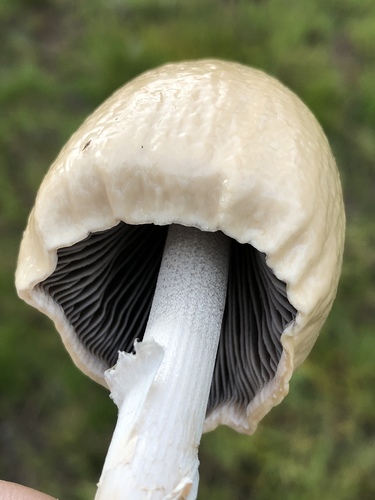
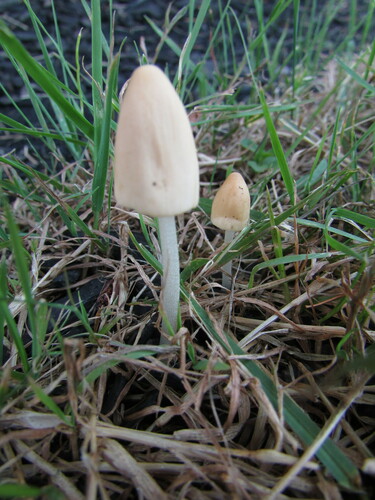
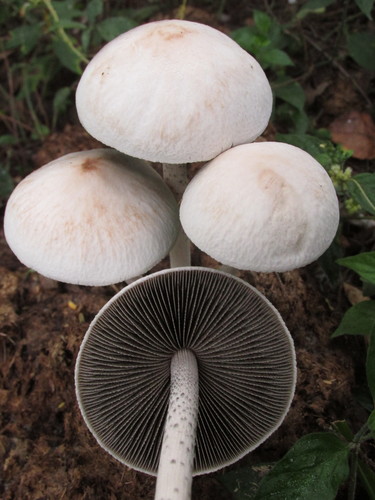
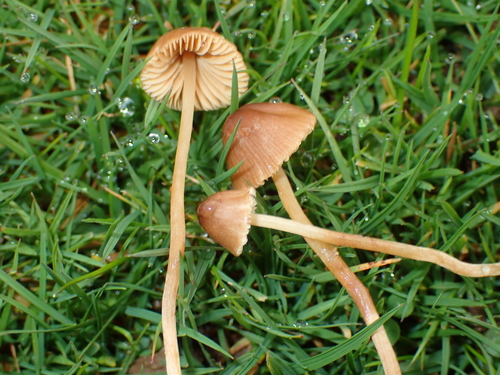
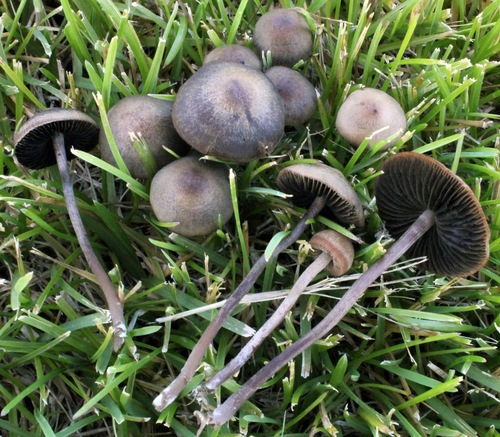
Panaeolus fimicola (Pers.) Gillet has the following physical characteristics. Its cap measures (1) 1.5–3.5(4) cm across, starting campanulate before expanding to convex then plane, with an obtuse shape. Cap color ranges from dingy gray to blackish, often with reddish or hazel tones, and it is hygrophanous, fading to pallid grey or yellowish when dry. The cap surface is smooth, with a narrow brown marginal band, and is slightly striate at the margin when moist. The cap flesh is thin and grayish. The gills are adnate, ranging from close to crowded. They start gray-olivaceous, then become mottled and darken to black as they age, while the gill edges remain whitish. Spores are blackish gray. The stipe measures (4) 6–8(10) cm long by 1–2(3) mm thick. It is equal and slender, slightly enlarging at the base, hollow, fragile, and colored dingy white to clay, becoming brownish toward the base with age. The stipe surface is smooth, white-pruinose at the apex, faintly and obsoletely silky-striate, and has no ring. Stipe flesh is dirty ochraceous-buff and fragile. The species has no distinctive taste and no distinctive odor. Microscopically, spores measure 10.8–14.2 by 6.9–9.5 µm, and are ellipsoid or lemon shaped. Basidia are 4-spored. Gill edge cystidia are fusiform, typically with long necks, and no cystidia are present on the gill face. Panaeolus fimicola grows solitary to scattered in soil or dung, fertilized lawns and other grassy areas, fruiting from late spring to mid-fall. It often appears during or after cold rain. It is widespread and common across the Americas, Europe, and Africa, and has also been found in Turkey.