About Panaeolus cyanescens Sacc.
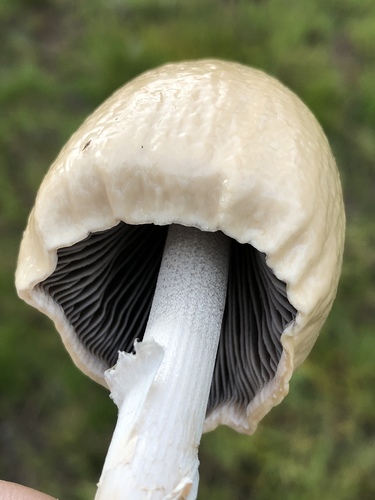
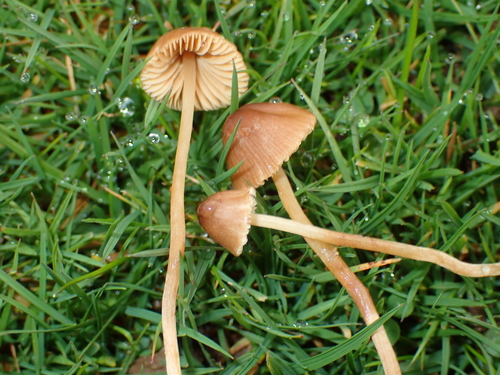
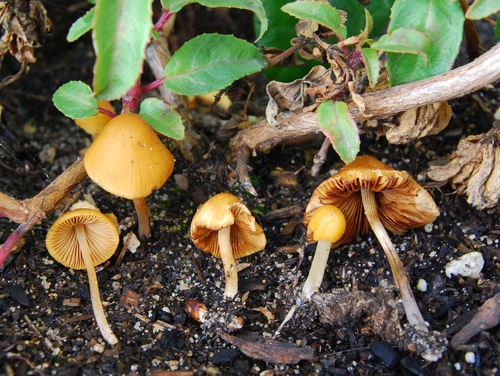
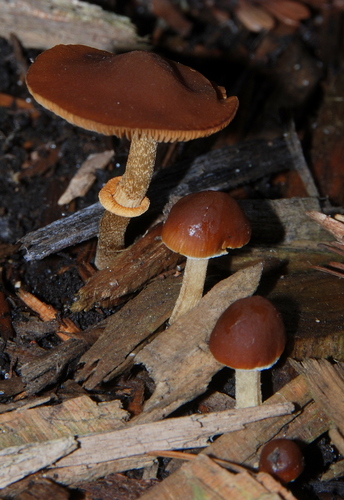
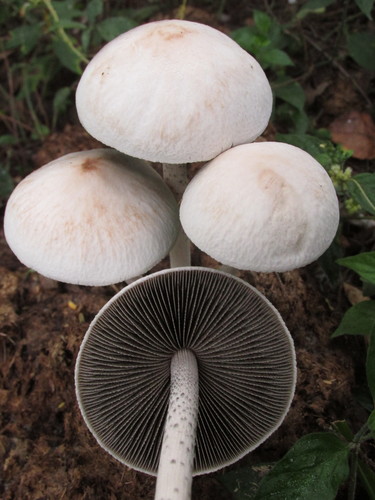
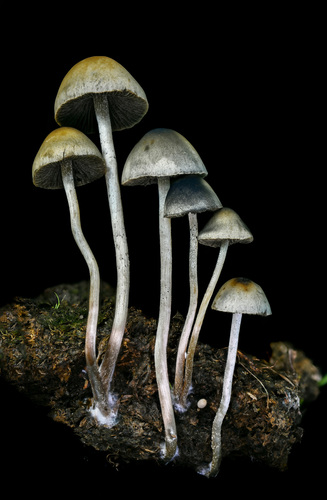
The cap of Panaeolus cyanescens Sacc. measures 1.5–4 centimetres (1⁄2–1+1⁄2 in) across. It is dry, initially hemispheric, and expands to become campanulate or convex, with an incurved margin when young. Young caps are light brown, fading to off-white or light gray at maturity, sometimes retaining yellowish or brownish tones. The cap often develops cracks in dry weather, is slightly hygrophanous, and turns greenish or blue in areas that are damaged. The gills are broadly adnate to adnexed and closely spaced; they begin gray and turn black as spores mature. Gill faces have a mottled appearance, and gill edges are white. The spore print of this species is black. The stipe is 6–12 cm long and 2 to 4 mm thick, equal in width to slightly enlarged at the base, pruinose, and colored similarly to the cap, staining somewhat blue when bruised. It has a farinaceous taste and odor. Panaeolus cyanescens is a coprophilous (dung-inhabiting) species that grows in both the Neotropics and Paleotropics. It has been recorded in Vietnam, Africa (including South Africa, Mauritius, Madagascar and Democratic Republic of the Congo), Australia, Belize, the Caribbean (Bermuda, Grenada, Barbados, Jamaica, Trinidad, and Puerto Rico), Costa Rica, India, Malaysia, Indonesia, Sri Lanka, Cambodia, Thailand, Japan, Mexico, Oceania (Fiji and Samoa), the Philippines, South America (Bolivia, Brazil, Paraguay, Colombia, Venezuela, and Ecuador), South Korea, and the United States (California, Hawaii, Louisiana, Mississippi, Alabama, Florida, Tennessee, Texas, Kentucky, Virginia, Georgia, and North Carolina).