About Panaeolus cinctulus (Bolton) Sacc.
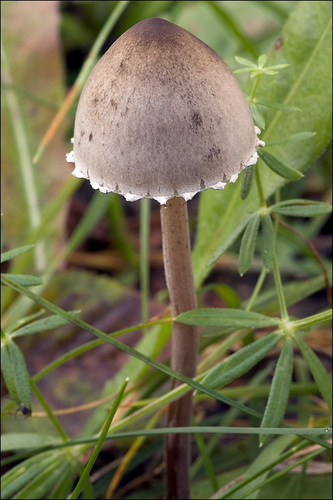
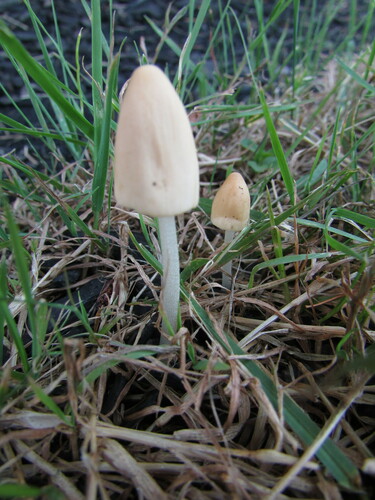
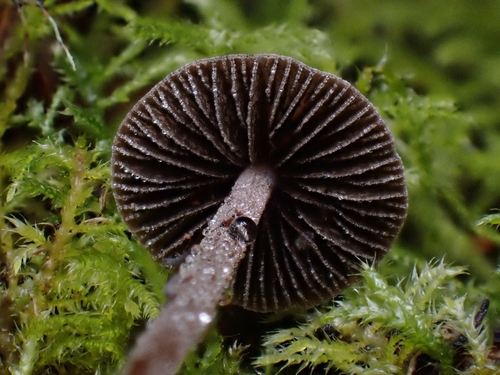
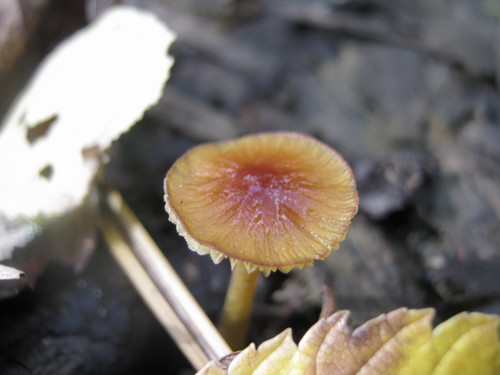
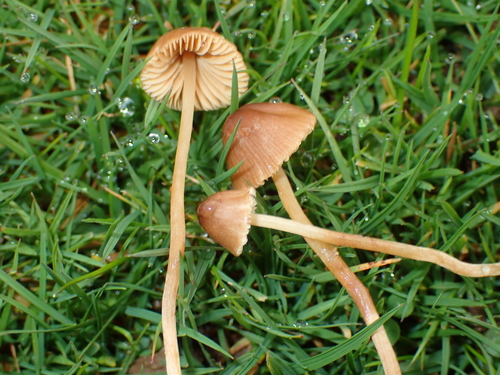
This species is Panaeolus cinctulus (Bolton) Sacc. Its cap is 1.5–6 centimetres (1⁄2–2+1⁄2 inches) wide. Young caps are hemispherical to convex, while mature caps become broadly umbonate or flat. The cap surface is smooth and hygrophanous: when moist it is a striking cinnamon-brown, and when very wet it turns soot-black; this dark coloration fades as the mushroom dries completely. A darker band is usually present along the outer edge of the cap. The flesh is thin and brownish. Gills are closely spaced, with attachment ranging from adnate to adnexed. Young gills are cream-colored, and mature gills become mottled dingy brown then turn soot-black. Gill edges are white and slightly fringed, and turn blackish when the mushroom reaches full maturity. The spore print is black. The stipe (stem) is 4–10 cm long and 1–10 mm thick, with a shape that is equal along its length or tapered at the ends. It is reddish brown, or sometimes covered in a whitish powder. The stipe is hollow, has no remaining veil tissue, is longitudinally white-fibrillose, and has striations at the apex, or vertical twisting striations along the entire length of the stipe. The stem base and associated mycelium occasionally stain blue. When fresh, the mushroom tastes farinaceous, meaning it has a flavor like fresh flour; when dried, the taste becomes saliferous, or salty. The odor is slightly farinaceous. Panaeolus cinctulus is a cosmopolitan species. It grows from solitary, to gregarious, to cespitose (densely clumped), and fruits on compost piles, well-fertilized lawns and gardens, and rarely grows directly on horse dung. It fruits from spring through fall, and grows abundantly after rain. It occurs in many regions across the globe, including South Africa (Africa), Austria, all provinces of Canada: Alberta, British Columbia, New Brunswick, Prince Edward Island, Ontario, Quebec, and Nova Scotia, Denmark, Finland, France, Germany, Great Britain, Guadeloupe, Estonia, Iceland, India, Ireland, Italy, South Korea, Japan, Mexico, New Guinea, New Zealand, Norway, Philippines, Russia, Romania, Slovenia, Argentina, Chile, and Brazil (South America), and the United States, where it occurs in all 50 states, and is common in Oregon, Alaska, Washington, and both northern and southern California. American mycologist David Arora notes that P. cinctulus is the most common psilocybin mushroom found in California. Additional confirmed sightings have been recorded in Melbourne, Australia, Central Queensland, Australia, Belgium, and the Czech Republic.