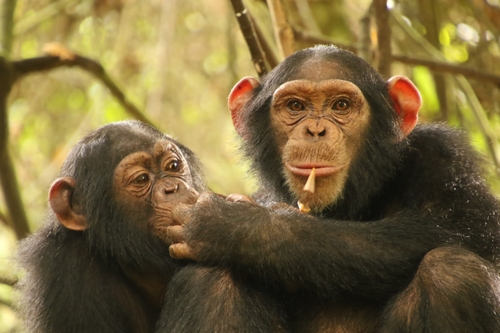
About Pan troglodytes (Blumenbach, 1775)
Scientific name: Pan troglodytes (Blumenbach, 1775)
Characteristics: On average, adult chimpanzees have a standing height of 150 cm (4 ft 11 in). Adult males in the wild weigh between 40 and 70 kg (88 and 154 lb), while adult wild females weigh between 27 and 50 kg (60 and 110 lb). In rare cases, individual chimpanzees can far exceed these measurements; captive chimpanzees may stand over 168 cm (5 ft 6 in) on two legs and weigh up to 136 kg (300 lb). Chimpanzees have a more robust build than bonobos, but a less robust build than gorillas. A chimpanzee's arms are longer than its legs, and extend below the knees. Their hands have long fingers, short thumbs, and flat fingernails. Their feet are adapted for grasping, with an opposable big toe. The chimpanzee pelvis is long, with an extended ilium.
A chimpanzee's head is rounded, with a prominent, prognathous face and a distinct brow ridge. They have forward-facing eyes, a small nose, rounded non-lobed ears, and a long, mobile upper lip. Adult males also have sharp canine teeth. Like all great apes, chimpanzees have a dental formula of 2.1.2.3 / 2.1.2.3: this means each half of both the upper and lower jaw holds two incisors, one canine, two premolars, and three molars. Chimpanzees do not have the prominent sagittal crest or the associated head and neck muscle structure that gorillas have.
Ecology: Chimpanzees are a highly adaptable species that lives in a wide range of habitats, including dry savanna, evergreen rainforest, montane forest, swamp forest, and dry woodland-savanna mosaic. At Gombe, chimpanzees mostly use semideciduous and evergreen forest, as well as open woodland. At Bossou, chimpanzees live in multistage secondary deciduous forest that grew after shifting cultivation, alongside primary forest and grassland. At Taï, chimpanzees live in the last remaining tropical rainforest in Ivory Coast.
Chimpanzees hold an advanced cognitive map of their home range that lets them repeatedly locate food. Each night, a chimpanzee builds a new sleeping nest in a tree, and never reuses an old nest. Except for infants or juveniles, which sleep with their mothers, chimpanzees sleep alone in separate nests.
Tool use: Tool use has been recorded in nearly all chimpanzee populations. Chimpanzees modify sticks, rocks, grass, and leaves, and use these modified materials when foraging for termites, ants, nuts, honey, algae, or water. While these tools are not complex, chimpanzees show clear forethought and skill when creating them. Chimpanzees have used stone tools for at least 4,300 years. A chimpanzee from the Kasakela chimpanzee community was the first reported nonhuman animal to make a tool: it modified a twig to use for extracting termites from their mound. At Taï, chimpanzees use only their hands to extract termites.
When foraging for honey from stingless bees, chimpanzees use modified short sticks to scoop honey out of the hive. For hives of the dangerous African honeybee, chimpanzees use longer, thinner sticks to extract honey. Chimpanzees also use this same tactic to fish for ants. Ant dipping is difficult, and some chimpanzees never learn to do it successfully. West African chimpanzees crack open hard nuts using stones or branches. This activity shows forethought, because the nuts and the tools used to crack them are not naturally found together in the collection area. Nut cracking is also a difficult skill that must be learned. Chimpanzees also use leaves as sponges or spoons to drink water.
West African chimpanzees in Senegal have been observed sharpening sticks with their teeth, then using the sharpened sticks to spear Senegal bushbabies out of small holes in trees. An eastern chimpanzee has been observed using a modified branch as a tool to capture a squirrel. Chimpanzees living in Tanzania have been found to deliberately select plant materials that produce more flexible tools for termite fishing.
Experimental studies on captive chimpanzees have found that many of the species' typical tool-use behaviours can be learned individually by each chimpanzee. However, a 2021 study testing chimpanzees' ability to make and use stone flakes, in a method similar to that hypothesised for early hominins, did not find this behaviour in two separate chimpanzee populations. This suggests that making and using stone flakes falls outside the typical species-wide range of chimpanzee tool use.
Use in research: Hundreds of chimpanzees have been kept in laboratories for research. Most of these laboratories either conduct invasive research, or make chimpanzees available for invasive research; this is defined as "inoculation with an infectious agent, surgery or biopsy conducted for the sake of research and not for the sake of the chimpanzee, and/or drug testing". Unlike most other laboratory animals, research chimpanzees are typically used repeatedly for decades, up to 40 years total. Two federally funded American laboratories currently house chimpanzees for research: the Yerkes National Primate Research Center at Emory University in Atlanta, Georgia, and the Southwest National Primate Center in San Antonio, Texas. Five hundred chimpanzees have been retired from laboratory use in the US, and now live in animal sanctuaries in the US or Canada.
In 1996, the US National Institutes of Health imposed a five-year moratorium on breeding chimpanzees for research, because too many chimpanzees had been bred for HIV research. This moratorium has been extended annually since 2001. After the chimpanzee genome was published, 2006 reports indicated that plans to increase the use of chimpanzees in American research were growing, with some scientists arguing that the federal moratorium on breeding chimpanzees for research should be lifted. In 2007, the NIH made the moratorium permanent.
Other researchers argue that chimpanzees should either not be used in research at all, or should receive different treatment, for example by being granted legal personhood. Pascal Gagneux, an evolutionary biologist and primate expert at the University of California, San Diego, argues that given chimpanzees' sense of self, tool use, and genetic similarity to humans, studies using chimpanzees should follow the ethical guidelines created for human subjects who cannot give consent. One recent study found that chimpanzees retired from laboratory research show a form of post-traumatic stress disorder. Stuart Zola, director of the Yerkes laboratory, disagrees with this claim. He told National Geographic: "I don't think we should make a distinction between our obligation to treat humanely any species, whether it's a rat or a monkey or a chimpanzee. No matter how much we may wish it, chimps are not human."
Only one European laboratory, the Biomedical Primate Research Centre in Rijswijk, the Netherlands, formerly used chimpanzees in research. It once held 108 chimpanzees among 1,300 non-human primates. The Dutch ministry of science decided to phase out chimpanzee research at the centre starting in 2001, though trials already underway were allowed to continue to completion. Chimpanzees, including the female Ai, have been studied at the Primate Research Institute of Kyoto University, Japan, since 1978; the institute was formerly directed by Tetsuro Matsuzawa. 12 chimpanzees are currently held at this facility.
Two chimpanzees have been sent into outer space as NASA research subjects. Ham, the first great ape in space, launched in the Mercury-Redstone 2 capsule on 31 January 1961, and survived the suborbital flight. Enos, the third primate to orbit Earth after Soviet cosmonauts Yuri Gagarin and Gherman Titov, flew on Mercury-Atlas 5 on 29 November of the same year.