About Pampa rufa (R.Lesson, 1840)
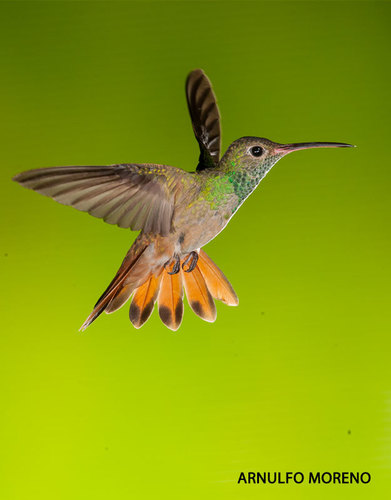
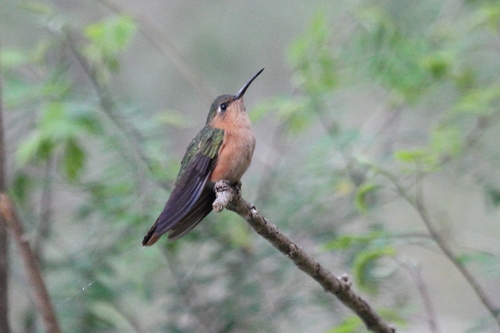
Scientific name: Pampa rufa (R.Lesson, 1840), commonly known as the rufous sabrewing. The rufous sabrewing is 12.1 to 14 cm (4.8 to 5.5 in) long, with an average weight of 7.5 g (0.26 oz). It has a straight, stout, broad black bill. The sexes have nearly identical plumage. Their upperparts are bright metallic bronze green to greenish bronze; the crown is slightly darker and duller, while the uppertail coverts are more bronzy. They have a cinnamon face with a white spot behind the eye, and cinnamon underparts that are slightly paler along the center. Their central pair of tail feathers is metallic bronze to greenish bronze. The next pair of tail feathers shares this base color, with a wide diffuse blackish band near the tip and cinnamon ends. The following two pairs have cinnamon bases, a sharper blackish band, and cinnamon tips. The outer web of the outermost tail feather pair is cinnamon. The rufous sabrewing is distributed along the western slope of highlands, ranging from the Sierra Madre de Chiapas in the Mexican state of Oaxaca, southeast through Guatemala, into El Salvador, reaching as far as Volcán de San Salvador in El Boquerón National Park. It inhabits the interior and edges of humid evergreen montane forest, pine-oak forest, and coffee and other agricultural plantations. It occurs at elevations between 900 and 2,000 m (3,000 and 6,600 ft), and is most abundant at elevations above 1,300 m (4,300 ft).