About Palythoa tuberculosa (Esper, 1805)
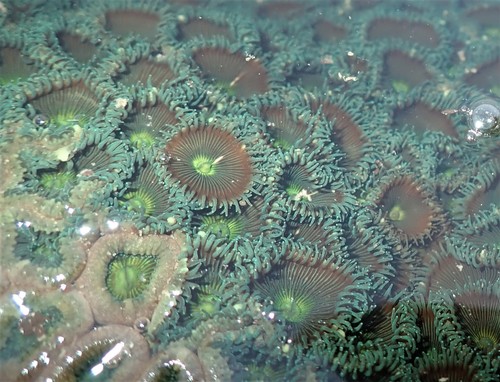
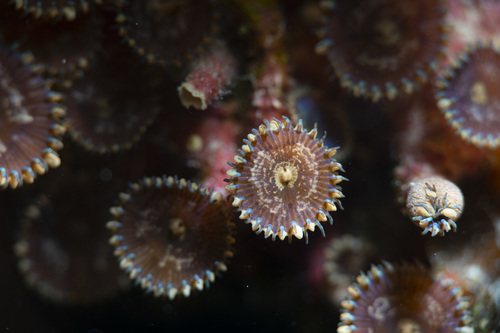
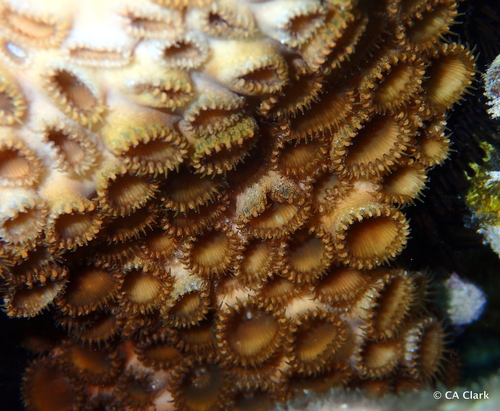
Like other zoanthids, Palythoa tuberculosa has no hard skeleton. It is made up of small polyps embedded in a thick, fleshy mat. The polyps are short and immersed in the surrounding tissue, and their tentacles are usually retracted during the day and extended at night. Colonies of this species can have a range of colors, including blue-gray, green, gray, brown, and pink shades. Palythoa tuberculosa is widely distributed throughout the Indo-Pacific, including areas such as Hawai'i, Japan, and the Great Barrier Reef. It lives in a variety of environments, from exposed rocky coastlines with strong wave action to sandy reef flats where colonies become encrusted with sand. On steep, sediment-free surfaces, colonies usually grow larger and stay free of sand, while in more sheltered habitats, smaller colonies develop with sand covering their surface. As a member of the order Zoantharia, Palythoa tuberculosa is a colonial, anemone-like organism that uses both heterotrophic and autotrophic feeding strategies. It captures planktonic prey with its tentacles, which hold specialized stinging cells called nematocysts. This species may contain palytoxin, so it is important to avoid eye or skin contact when handling or observing this cnidarian. Palythoa tuberculosa also hosts symbiotic zooxanthellae, which are photosynthetic algae that supply nutrients to their host through photosynthesis.