About Palpada agrorum (Fabricius, 1787)
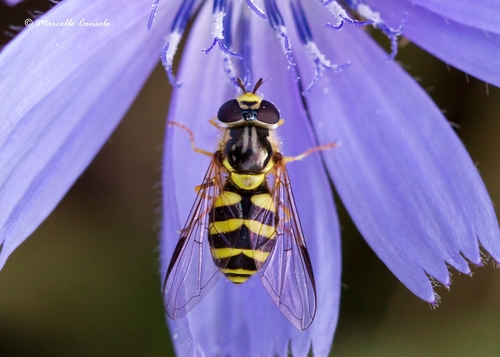
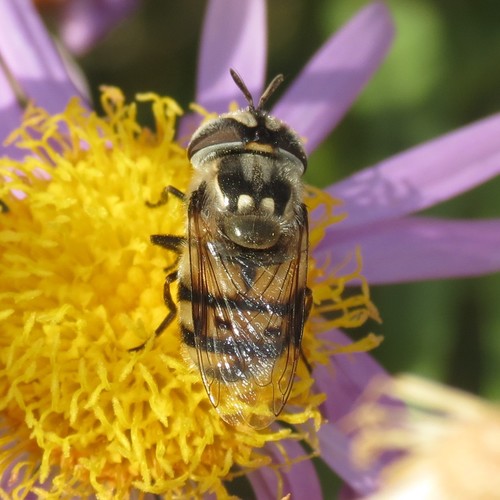
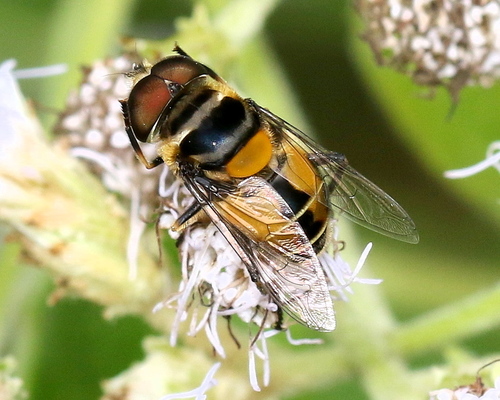
Scientific name: Palpada agrorum (Fabricius, 1787). For morphological terms used in this description, please refer to Morphology of Diptera. Head: The face is covered by white pollen and thick, pure white pile, which is more abundant on the frontal triangle. The facial stripe and cheeks are shining black. The eyes are covered in pile, and males have holoptic eyes. Antennae are faintly reddish or ferruginous, with a bare arista. Thorax: The scutum is black, covered with yellowish-white pile on its front section, mixed with blackish pile on the back section. In front of the suture sits a broad, conspicuous grayish pollinose band, and on each side an oblique spot extends from the wing root backward toward the scutellum. The scutellum is yellow with a narrowly black base, and females have black pile on the scutellum. This species differs from related forms by having a complete grayish band on the thorax dorsum in front of the scutellum. The meron has fine pale hairs in front of or below the spiracle. Abdomen: The first abdominal segment is black, with yellow outer angles. The second segment is light yellow, with a narrow median opaque black stripe that does not quite reach the hind margin and is a little broader at the front. The third segment is black, with an anterior oval reddish yellow spot on each side that connects to the yellow marking of the preceding segment, and the hind border is yellow. The fourth segment is black, with a yellow hind border and a narrow interrupted shining fascia that is wider on the sides. The hypopygium is shining black with light-colored pile. Pile is black on the opaque portions of the abdomen, and yellow on the yellow spots. In females, the second abdominal segment has a broad opaque black area in the middle; this area is narrower at the front and extends as a fascia to the lateral abdominal margin at the back. The third and fourth segments each also have a narrow, interrupted shining fascia, and the lower part of the front is not entirely covered in white pile. Wing: The wings are hyaline, and sometimes faintly clouded across the middle and outer sections. Near the end of the marginal cell, the second vein (R2+3) curves distinctly into the submarginal cell. Cell r2+3 closes before the wing margin. Legs: The legs are mostly black. The knees, basal third of the front and hind tibiae, basal half of the intermediate tibiae, and the middle metatarsi are light yellow. The extreme base of the anterior metatarsi is luteous. The hind femora are dilated. This species is distributed across North and South America, and is most commonly found in the southeastern United States.