About Palomena prasina (Linnaeus, 1761)
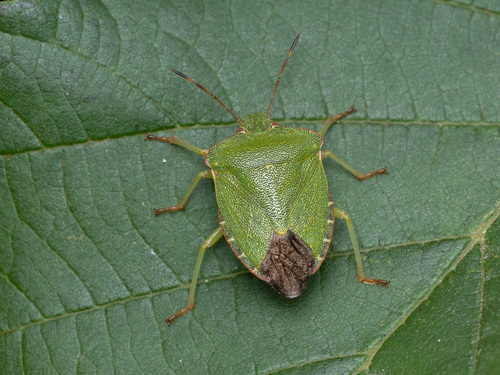
The green shield bug, Palomena prasina, is a Palearctic shield bug species belonging to the family Pentatomidae. The name "green shield bug" can also refer to several other species in the tribe Nezarini. If called a "green stink bug", the name is more appropriately applied to the larger North American species Chinavia hilaris. Adult green shield bugs have back colouration that ranges from bright green to bronze, with no prominent markings. This is a very common shield bug across Europe, including the British Isles, and it inhabits a wide variety of environments, including gardens. It has been recorded as far north as 63° N latitude. In Europe, bright green adult green shield bugs emerge in April or May, after overwintering as mature adults (imagoes) in humus. They feed on sap from plants, including commercial crops such as apples, pears, and hazelnuts. They feed and gain weight for one month, then mate in June. Mating occurs back-to-back. Over the summer months, the adult's colour shifts from green to greenish brown or even bronze, in preparation for autumn, when this generation's life cycle ends. Females lay eggs in hexagonal batches of 25 to 30, and a single female produces three to four batches total. After hatching, green shield bugs enter their first nymphal stage (referred to here as a larval stage), and newly hatched nymphs stay together in sibling groups. This grouping is enabled by an excretion of an aggregation pheromone. When threatened, a different pheromone is released that triggers the group to disperse. After the first nymphal stage, individuals go through four more nymphal stages, with a moult between each stage. Green shield bugs have distinct colouration in each nymphal stage, ranging from light brown to black or green-black. In the final imago stage, individuals are bright green with short wings. The imago stage is typically reached in September, and hibernation begins in November.