About Palinurus elephas (Fabricius, 1787)
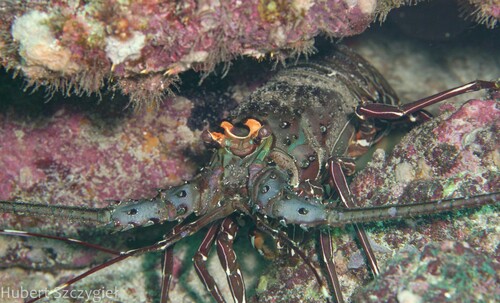
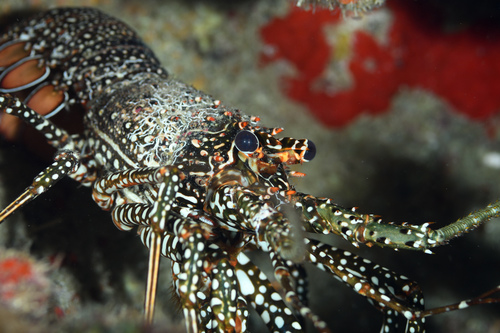
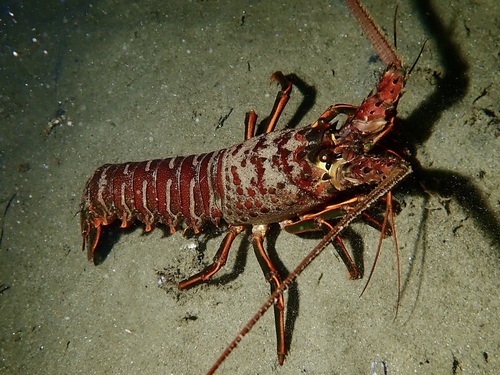
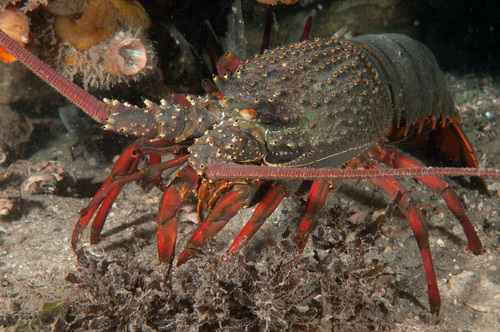
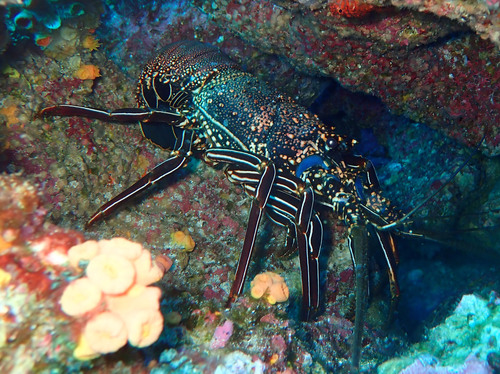
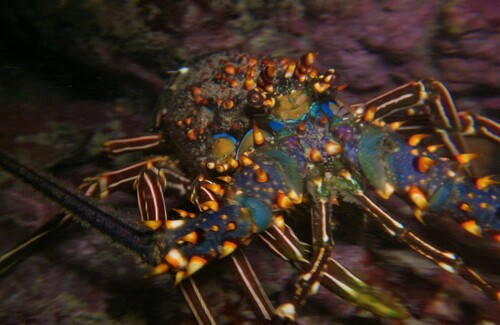
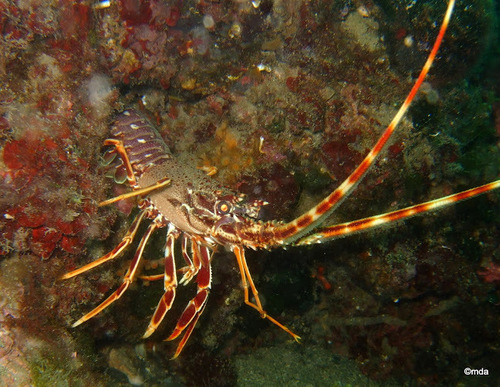
Palinurus elephas (Fabricius, 1787), commonly known as the spiny lobster, may reach up to 60 cm (24 in) in total length, though individuals are rarely longer than 40 cm (16 in), and most adults measure 25–30 cm (10–12 in) long. Few individuals reach their recorded maximum weight of several kilograms. Adult P. elephas are reddish-brown with yellow spots. Its carapace is slightly compressed, lacks lateral ridges, and is covered in forward-pointing spines, with prominent supraorbital spines. Its antennae are very heavy and spiny, taper toward their ends, and are even longer than the lobster's body. The first walking leg, called a pereopod, has a subchela, which is a prehensile structure formed at the distal end of the limb. The merus, the fourth segment of this leg, has a characteristic row of spines. P. elephas is a common spiny lobster species found in the eastern Atlantic Ocean, ranging from southern Norway to Morocco and the Azores, and throughout most of the Mediterranean Sea, excluding its eastern extremes. It inhabits rocky exposed coasts below the intertidal zone, mainly at depths of 20 to 70 metres (66 to 230 ft). The species is named for Palinurus, an ancient Roman port on the Tyrrhenian Sea (modern-day Palinuro, Campania, Italy), where P. elephas is abundant off the local promontory. The breeding season for P. elephas occurs in September and October. Females brood reddish eggs, which hatch around six months later in spring, producing flattened, leaf-shaped, planktonic larvae called phyllosoma larvae. P. elephas goes through ten phyllosoma stages and one puerulus stage before reaching adulthood. P. elephas is a highly sought-after food delicacy, widely caught for consumption around the Mediterranean Sea and along the Atlantic coasts of Morocco, Portugal, Spain, and southern France, mostly using lobster pots. It is also caught less intensively off the Atlantic coasts of Britain and Ireland. There are also small fisheries for the species on the west coast of Scotland, which use either tangle nets or lobster pots. P. elephas is the main ingredient in most traditional lobster dishes from Mediterranean shores, including the Menorcan dish caldereta de langosta, a type of lobster stew.