About Paleosuchus palpebrosus (Cuvier, 1807)
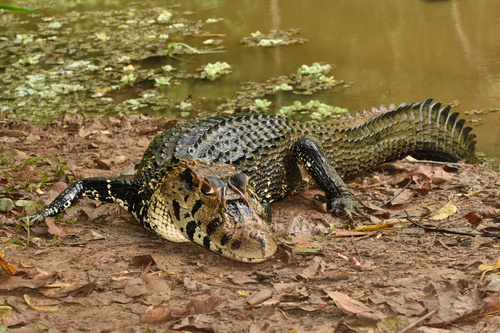
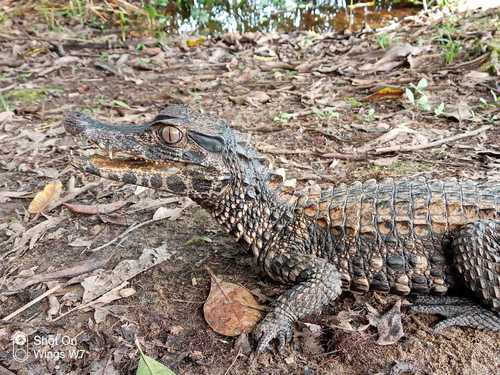
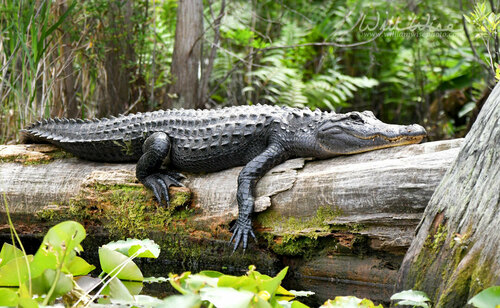
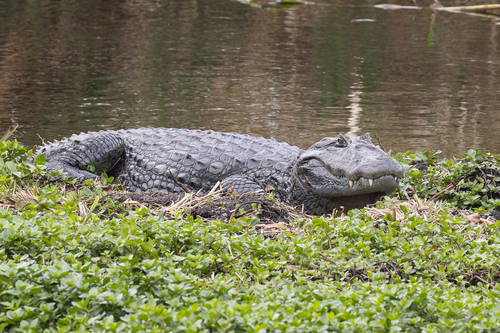
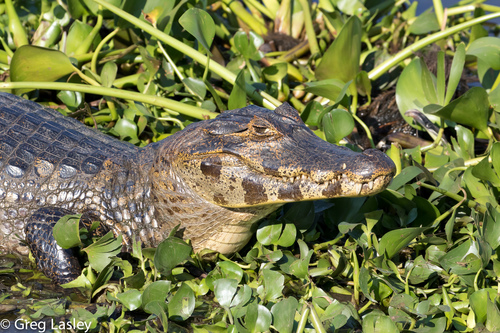
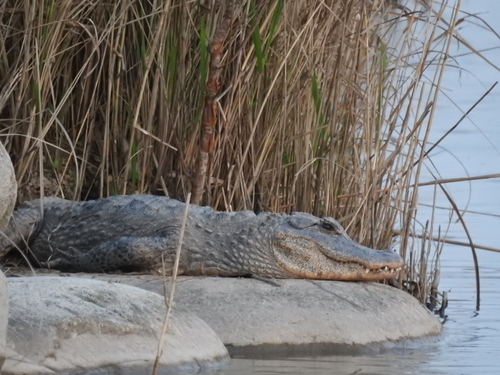
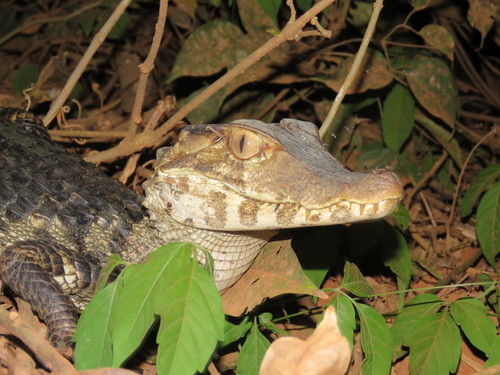
Cuvier's dwarf caiman (Paleosuchus palpebrosus) is the smallest living New World crocodilian. Males reach a maximum length of around 1.6 m (5.2 ft), while females usually do not exceed 1.2 m (3 ft 11 in). The largest confirmed specimen on record measured 1.73 m (5.7 ft) long. This maximum size estimate may be an undercount, because nearly all large adults have lost the tips of their tails; one large specimen measured in the Pantanal region had a snout–vent length of 1.125 m (4 ft), which would equal a total length of 2.1 m (6.9 ft) with an intact tail. A typical adult weighs 6 to 7 kg (13 to 15 lb), around the same weight as a 6- to 12-month-old individual of many larger crocodilian species. Large adult Cuvier's dwarf caimans can weigh up to 37 kg (82 lb). This species has strong body armor made of bony-based dermal scales called osteoderms on both its dorsal (upper) and ventral (lower) sides. This armor may offset its small body size by lowering predation risk. It has an unusual head shape for a crocodilian, with a dome-shaped skull and a short, smooth, concave snout with an upturned tip that resembles a dog's head. The upper jaw extends noticeably further forward than the lower jaw. On each side of the upper jaw, there are four premaxillary teeth and 14 to 15 maxillary teeth, while each side of the lower jaw has 21 or 22 teeth, giving a total of around 80 teeth. The neck is relatively slender, and its dorsal scutes are less prominent than those of the smooth-fronted caiman. The double rows of scutes on its tail are small and project vertically. Adults are dark brownish-black with a dark brown head, while juveniles are brown with black bands. The irises are chestnut brown at all ages, and the pupils are vertical slits. Scale arrangement (scutellation) can be used to tell Cuvier's dwarf caiman apart from Schneider's dwarf caiman. Cuvier's dwarf caiman is native to tropical northern and central South America. It occurs in the Orinoco River, São Francisco River, and Amazon River drainages, as well as the upper reaches of the Paraná River and Paraguay River. It can be found in Peru, Ecuador, Colombia, Venezuela, Guyana, Suriname, French Guiana, Brazil, Bolivia, Trinidad, and Paraguay. Its range is larger than that of the sympatric smooth-fronted caiman, as it extends into Paraguay and covers a larger area of Brazil. Unlike smooth-fronted caimans, Cuvier's dwarf caimans follow seasonal water-level fluctuations, which may allow the two species to live in sympatry. This is a freshwater species found in forested riverine habitats and flooded forest areas around lakes. It prefers fast-flowing rivers and streams, but can also be found in quiet, nutrient-poor waters in Venezuela and southeastern Brazil. It can travel large distances overland at night, and subadult individuals have sometimes been found in isolated, temporary pools. In the northern and southern parts of its range, it also occurs in gallery forests in savanna landscapes, but is absent from these types of habitats in the Llanos and the Pantanal. Compared to other caiman species, Cuvier's dwarf caiman is relatively tolerant of cool water. During the day, individuals sometimes rest in burrows, and at other times rest on rock piles or bask in shallow water with their backs exposed, facing the sun. These caimans are primarily nocturnal. Because they occupy many different microhabitats, their diet is thought to vary by region. Adults feed on fish, amphibians, small mammals, birds, crabs, shrimp, molluscs, insects, and other invertebrates, which they capture in water or on land. Juveniles eat less fish, and consume crustaceans, tadpoles, frogs, and snails, as well as terrestrial invertebrates like beetles. Prey is mostly swallowed whole, and ground up by stones in the gizzard. In the Pantanal, Cuvier's dwarf caiman estivates in burrows during the dry season, and can maintain a body temperature around 22 °C (72 °F) for multiple days at a time. Adult Cuvier's dwarf caimans are usually found alone or in pairs. Breeding in this species has been little studied, but does not appear to be seasonal. Females build a concealed mound nest from vegetation and mud, lay a clutch of 10 to 25 eggs, then hide the eggs under additional vegetation. Nest temperatures range from 26–31 °C (78–88 °F), with heat provided by decaying vegetation. The incubation period is around 90 days, and the sex of hatchlings is determined by nest temperature during incubation. When eggs start to hatch, the female opens the nest in response to calls from the young. Newly hatched juveniles have a mucus coating, and may delay entering the water for a few days until the mucus dries. This remaining mucus on their skin is thought to reduce algal growth. Females stay with their young for around a year, with the longest recorded parental care extending to 21 months, after which the juveniles disperse. Young caimans grow 8 to 10 cm (3 to 4 in) per year. Females reach sexual maturity at around 8 years old, while males reach sexual maturity at around 6 years old. Cuvier's dwarf caiman is considered a keystone species; its presence maintains a healthy organism balance in its ecosystem, and piranhas and other fish might come to dominate the environment without it. Eggs and newly hatched young are the most vulnerable to predation, preyed on by herons, birds of prey, snakes, large rats, crab-eating raccoons, and other mammals like opossums. Adults are protected by bony osteoderms under their scales, and their main predators are jaguars, green anacondas (Eunectes murinus), and large boa constrictors (Boa constrictor). Cuvier's dwarf caiman is the only crocodilian species that appears to not use the nearly universal "death roll" technique that other living crocodilians use for feeding or intraspecific combat. However, this observation may only be circumstantial, as specimens tested for this behavior may have simply refused to cooperate with researchers.