About Palaemon serratus (Pennant, 1777)
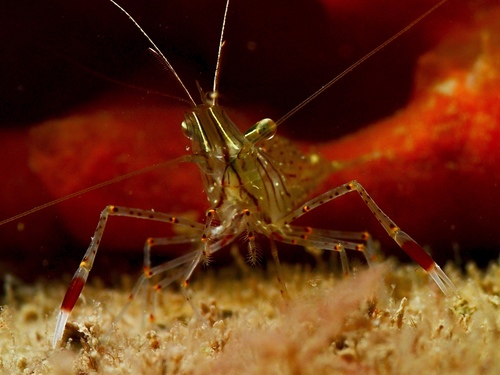
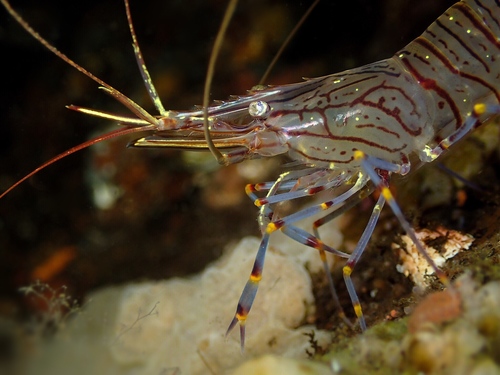
Palaemon serratus can be distinguished from other shrimp species by its rostrum, which curves upward, is bifurcated at the tip, has 6–7 teeth along its upper edge, and 4–5 teeth on its lower edge. While other species may have a slightly curved rostrum, their dorsal surface teeth extend into the distal third of the rostrum; the distal third is untoothed in P. serratus. This species is pinkish brown with reddish patterns, and typically reaches 100 millimetres (3.9 in) in length, making it the largest native shrimp or prawn species around the British Isles. Palaemon serratus is one of the few invertebrates whose hearing has been studied in detail. It is sensitive to frequencies between 100 Hz and 3 kHz, with hearing acuity similar to that of generalist fish. Although an individual's hearing range changes as it grows, all P. serratus are able to detect 500 Hz tones. In ecology, individuals live in groups for 3–5 years within rocky crevices, at depths up to 40 metres (130 ft). Females grow faster than males, and populations are highly seasonal, with a pronounced peak in abundance in autumn. P. serratus is preyed on by a variety of fish, including species from the families Mullidae, Moronidae, Sparidae and Batrachoididae. P. serratus can sometimes develop a prominent bulge in the gill region of its carapace, caused by an isopod parasite such as Bopyrus squillarum.