About Palaemon macrodactylus M.J.Rathbun, 1902
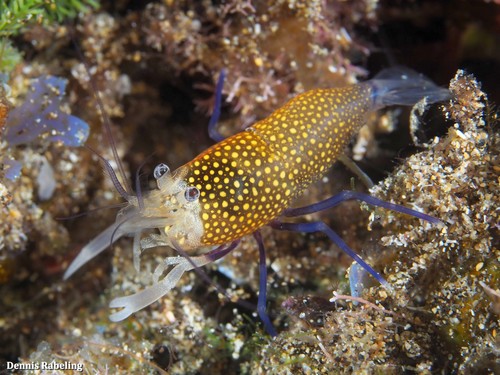
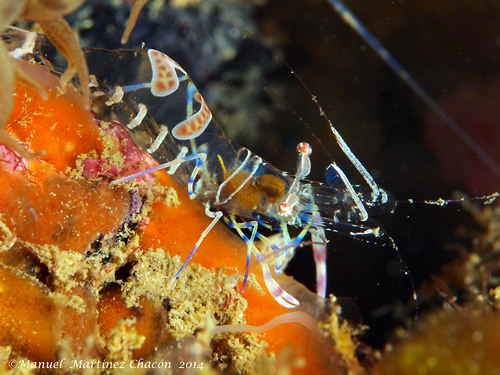
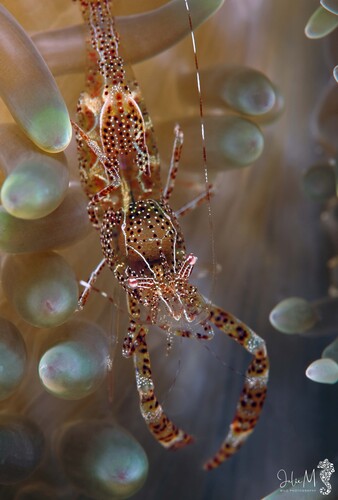
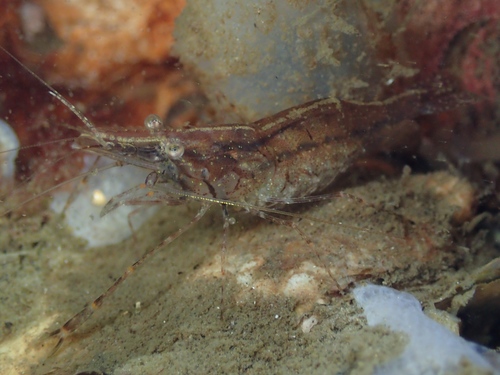
This species, Palaemon macrodactylus M.J.Rathbun, 1902, shows clear size differences between male and female individuals. Males are typically 9.7 to 13.5 mm (0.38 to 0.53 in) in length. Non-ovigerous (non-egg-bearing) females usually measure 11.8 to 14.1 mm (0.46 to 0.56 in) in length, while ovigerous (egg-bearing) females are larger, at approximately 16.5 to 19 mm (0.65 to 0.75 in) in length. Ovigerous females carry between 150 and 2000 eggs. Overall, females tend to be larger than males, and also differ in pigmentation: females have red spots across their body surface, plus white longitudinal stripes running down their back. Males have transparent bodies, with a reddish hue on the tail fan and antennary area. Due to morphological similarities, it is not easy to distinguish native local species from this introduced, alien species. Embryos of this species are able to develop in vitro under conditions that match those suitable for adults, but full embryonic development is more successful in high salinity conditions. Palaemon macrodactylus is native to Japan, Korea, Northern China, and the Far East region of Russia, in the Northwest Pacific Ocean. In 1957, the first non-native population of P. macrodactylus was accidentally introduced to San Francisco Bay, USA. Today, it is officially classified as an invasive species in California, USA, where it is very abundant. In North America, this species can also be found in the U.S. states of Washington, Oregon, Virginia, Connecticut, and New York. In the early 2000s, P. macrodactylus was first recorded in Australia and Argentina. It is believed that introduction to Mar de Plata harbor, Argentina, happened accidentally via ballast water discharge from the U.S., and this occurrence was the first reported record of the species on the southwestern Atlantic coast. Along the Atlantic coasts of Europe, the species occurs at multiple localities, including southwestern Spain, southeastern England, France, Belgium, and the Netherlands. It is considered invasive because it has successfully colonized the northeastern Pacific coast and its estuaries. Palaemon macrodactylus has a broad tolerance for different water conditions, which lets it occupy a wide range of aquatic environments globally, including brackish and marine coastal waters. Its optimal salinity range is between 5 and 15 parts per thousand (ppt), which counts as moderately saline water. The species primarily lives in the low salinity regions of estuaries. It favors habitats that provide shelter, including pilings, walls, and debris, and is usually most abundant in lower-salinity waters. Reproduction in Palaemon macrodactylus follows dioecism, meaning each individual shrimp has either male or female reproductive systems. As with other shrimp, a courting ritual is common, and mating relies on olfactory and tactile cues for indirect sperm transfer. In regulator shrimp (the group this species belongs to), mating occurs when the male positions itself at a ninety-degree angle to the female, then transfers its spermatophore to an area on the female's abdomen. Females start producing eggs within 6 to 20 hours after this process. For P. macrodactylus, the mating season runs from mid April to early October.