About Pagurus prideaux Leach, 1815
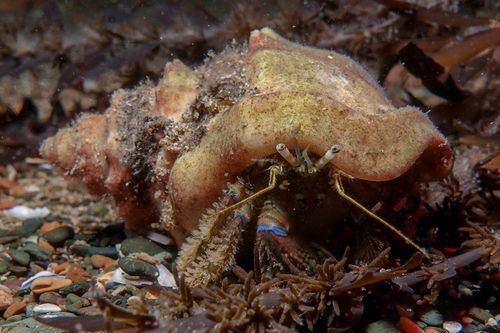
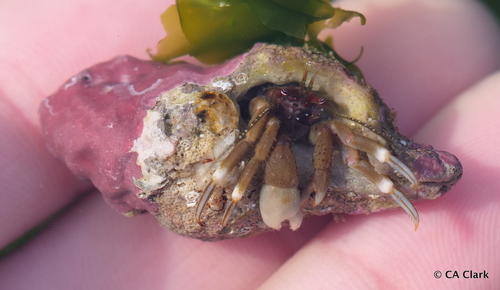
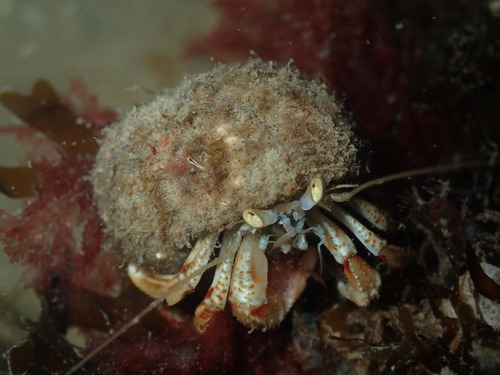
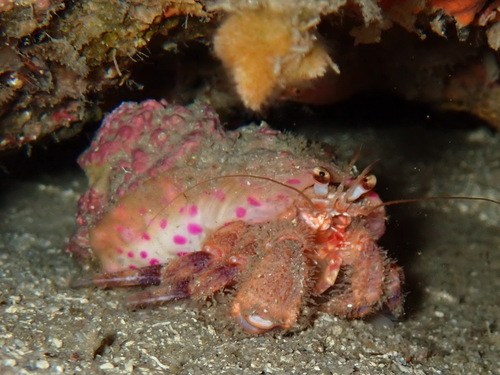
Like other hermit crabs, Pagurus prideaux has an asymmetric, unarmoured abdomen. It protects this abdomen by hiding it inside the empty shell of a suitably sized and shaped gastropod, and carries the shell around by clinging to an internal section of the sea snail shell's columella. The crab's carapace is brownish-red with paler patches, and is noticeably wider than it is long. It bears several tufts of short bristles, and the crab can reach a total length of 14 mm (0.6 in). The right cheliped is larger than the left, is tipped with a pincer, and can block the entrance to the occupied shell. Pagurus prideaux occurs on sand, gravel and mud in the intertidal zone and the shallow sublittoral, and it particularly favours muddy areas mixed with shell fragments and gravel. It is distributed across the Mediterranean Sea, the North Sea, and the northeast Atlantic Ocean, ranging from Cape Verde northward to Norway. Pagurus prideaux is almost always found in a symbiotic association with the cloak anemone Adamsia palliata. This anemone grows on the underside of the gastropod shell the hermit crab inhabits. The anemone's base expands, and two of its flaps wrap around the shell until they meet at the top. The anemone's base secretes a chitinous membrane that extends the original gastropod shell, increasing its internal capacity and letting the hermit crab stay in the shell for a longer time. In this symbiosis, the anemone's nematocysts reduce the crab's risk of predation, while the anemone gains food from fragments stirred up by the crab's activity. Pagurus prideaux also has a symbiotic relationship with the polychaete worm Iphitime paguri. Adult worms and larval stages of this worm are commonly found in the apex of the occupied gastropod shell, while intermediate-sized worms live in the crab's gill chambers and in a groove under the crab's carapace.