About Pagurus novizealandiae (Dana, 1852)
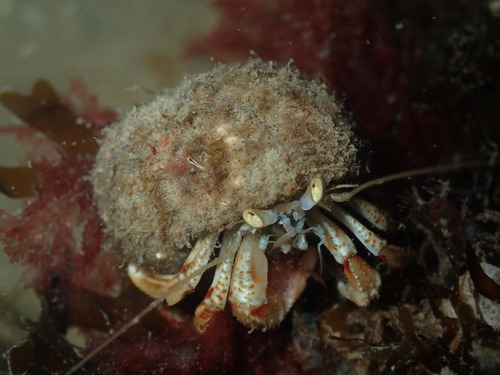
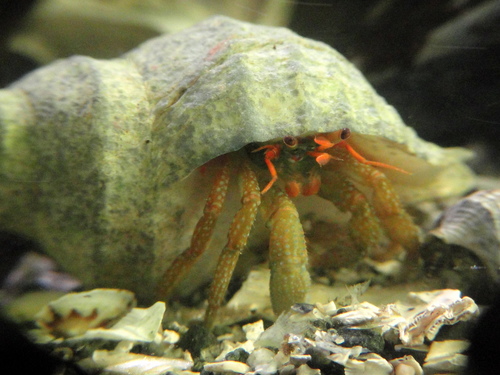
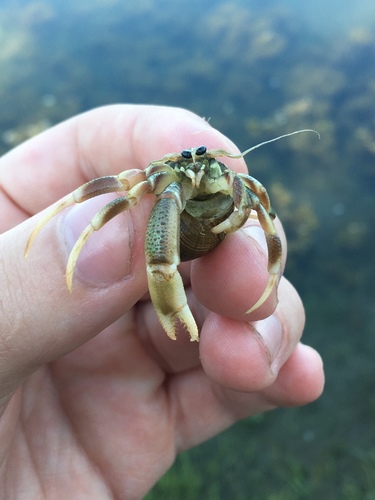
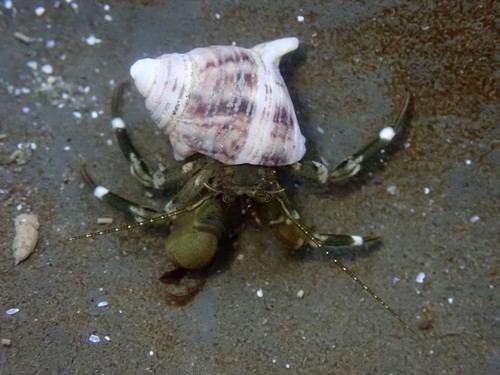
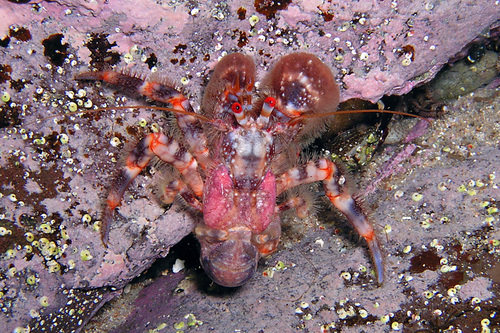
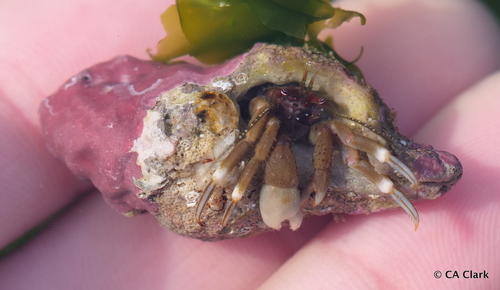
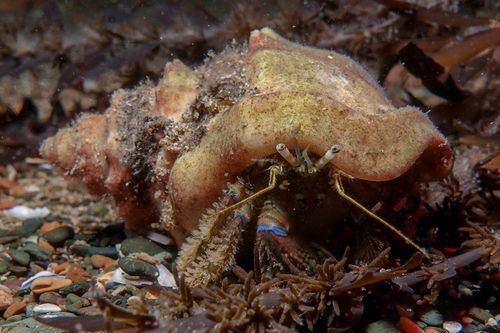
Pagurus novizealandiae is a hermit crab species identifiable by the colouration of its antennae and antennules, the small antenna-like structures located in front of the actual antennae. Adults are roughly the size of a coin, with an average length of 56 millimetres; their maximum size is limited by the size of available shells. Their bodies can reach up to 16 millimetres (0.63 inches) wide. Their abdomens are spiral, flexible, and able to twist, letting them fit easily into the different shells they occupy throughout their lives. To escape predators and danger, the crab quickly contracts back into its shell to stay out of reach. Once retreated, it uses its large chela as a protective door to block the shell opening. Throughout their lives, these hermit crabs occupy empty mollusk and gastropod shells including cat's eyes, snails, and periwinkles to protect their soft, vulnerable abdomens. They carry these shells on their backs using modified small legs, which let their back end grip the interior of the shell, and use abdominal muscles to hold themselves securely in place. As they grow, hermit crabs must move to larger shells to fit their increasing body size. Pagurus novizealandiae is endemic to New Zealand, and has not been recorded naturally occurring anywhere else in the world. Over 60 known hermit crab species exist in New Zealand, most found along coastlines in tidal rock pools and estuaries. This species occurs throughout intertidal zones of both the North and South Islands of New Zealand, but is most common in the South Island, and is also found on the Auckland Islands, 465 kilometres south-east of mainland New Zealand. Pagurus novizealandiae lives exclusively in marine environments, around rocky intertidal shorelines or rocky subtidal reefs. It cannot tolerate high dilution of seawater at all, so it cannot survive in freshwater habitats. It is generally restricted to areas such as estuaries with strong tidal activity, where water salinity stays consistently high enough to meet the species' needs. Due to its tidal habitat, it can be found at depths ranging from low tide to approximately 15 metres. Moulting is an essential part of Pagurus novizealandiae's life cycle, required for growth and development, repair of damaged limbs or other abdominal body parts, and preparation for reproduction. The moulting process, where the crab sheds its exoskeleton, happens while the crab remains inside the enclosed space of its shell. A new soft shell forms underneath the old exoskeleton, and the crab must wait a few days for this new shell to harden before it can leave to find a new larger shell. After moulting, the hermit crab has increased in size, so it must find a larger shell to accommodate its body. Hermit crabs may also need to switch shells when their current shell wears out naturally, becomes damaged by predators, or becomes overgrown. There is high competition for suitable shells, so crabs seek out new shells as quickly as possible to stay safe from predators. Timing and location are important factors when selecting where to moult. Both male and female Pagurus novizealandiae produce attractive sex pheromones. Males are aggressive during breeding and are typically dominant over females. While the sperm transfer behaviour of this species is unique to P. novizealandiae, the process still involves aligning gonopores on the crabs' legs to transfer sperm from the male to the female. Females have two to three pleopods, which carry the fertilised eggs. A glue-like substance covers the eggs, helping them adhere to the female's abdomen. The female keeps the eggs protected inside her shell away from danger until embryonic development is complete. When the eggs are ready to hatch and be released, they release a pheromone that stimulates the female. The female's movements help hatch the eggs, which are then released into plankton. Larvae take weeks to months to develop, going through several distinct larval stages before reaching the final juvenile stage, where they first occupy a small fragment of a broken snail shell. Once they become juvenile hermit crabs, they begin searching for a suitable full shell.